


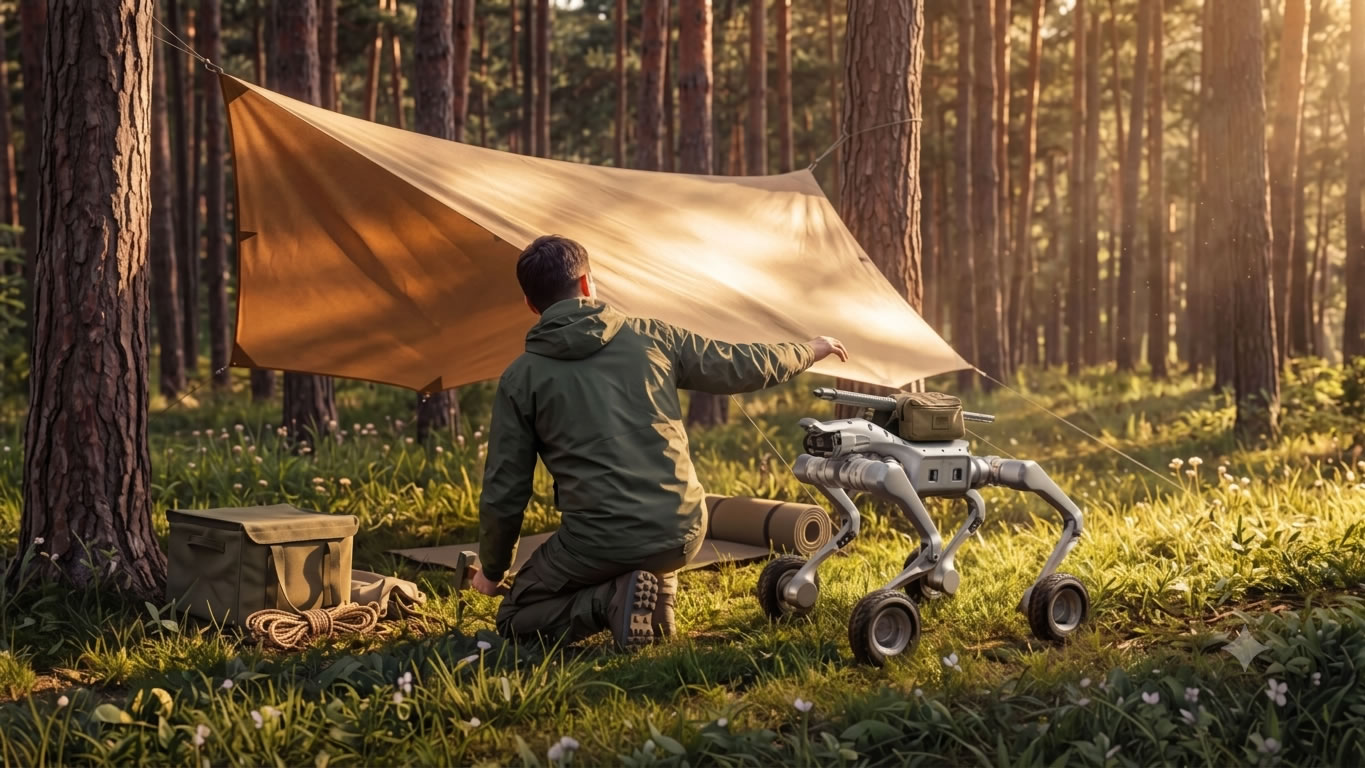
A video showing Unitree’s new AS2-W robot navigating rugged outdoor terrain has recently drawn attention from robotics enthusiasts and hikers, raising a question that once seemed closer to science fiction: could robot companions eventually become part of everyday exploration?
The footage, originally released on Unitree’s official channels, shows the wheeled-leg quadruped moving across uneven mountain terrain, maintaining balance while crossing rocks, slopes, and rough surfaces. Unlike traditional robot demonstrations that focus on impressive jumps or acrobatic movements, the AS2-W video demonstrates something more practical — a robot designed to keep moving when the environment becomes unpredictable.
Indian industrialist Harsh Goenka shared the video on social media and described the robot as a potential future travel companion, highlighting its ability to navigate challenging terrain. The post quickly attracted attention, triggering discussions about whether robots could one day become a standard piece of hiking equipment alongside GPS devices, cameras, and outdoor gear.
While a personal robot companion for hikers is still far from reality, the interest around AS2-W points to a wider shift in robotics. Companies are increasingly moving beyond laboratory demonstrations and exploring how mobile robots can operate in real-world environments.
Developed by Chinese robotics company Unitree Robotics, the Unitree AS2-W adopts a different design philosophy for quadruped robots. Instead of relying only on legs, it combines articulated legs with powered wheels, allowing the robot to switch between efficient wheeled locomotion on smooth surfaces and legged movement over difficult terrain.
A New Approach: Combining Wheels With Legs
Traditional quadruped robots are built to handle environments where wheels struggle — stairs, gravel, slopes, and uneven ground. However, on suitable surfaces, wheeled movement is generally faster and more energy efficient than walking with four mechanical legs.
The AS2-W is designed to combine both advantages.
On flat roads, factory floors, or park trails, the robot can use its wheels to achieve higher speeds. When facing obstacles such as rocks, steps, or steep slopes, it can rely on its articulated legs to adjust its posture and maintain stability.
Unitree’s official specifications list the AS2-W’s maximum speed at more than 6 meters per second, with a total weight of approximately 25 kilograms including the battery. It can climb obstacles up to 80 centimeters high and handle slopes of around 45 degrees.
This hybrid design mirrors a growing trend in mobile robotics. Instead of building robots that imitate humans or animals as closely as possible, engineers are increasingly focusing on creating machines optimized for specific environments.
How AS2-W Compares to Spot and ANYmal
To understand where the AS2-W fits, it helps to look at established competitors. Boston Dynamics’ Spot, one of the best-known quadruped robots, uses pure leg locomotion. Spot can traverse stairs and rough ground with exceptional stability, but its top speed is limited to about 1.6 meters per second. Its standard payload capacity is roughly 14 kilograms. It is widely used for inspection and data collection, with prices generally reported around $75,000 before additional payloads and services.
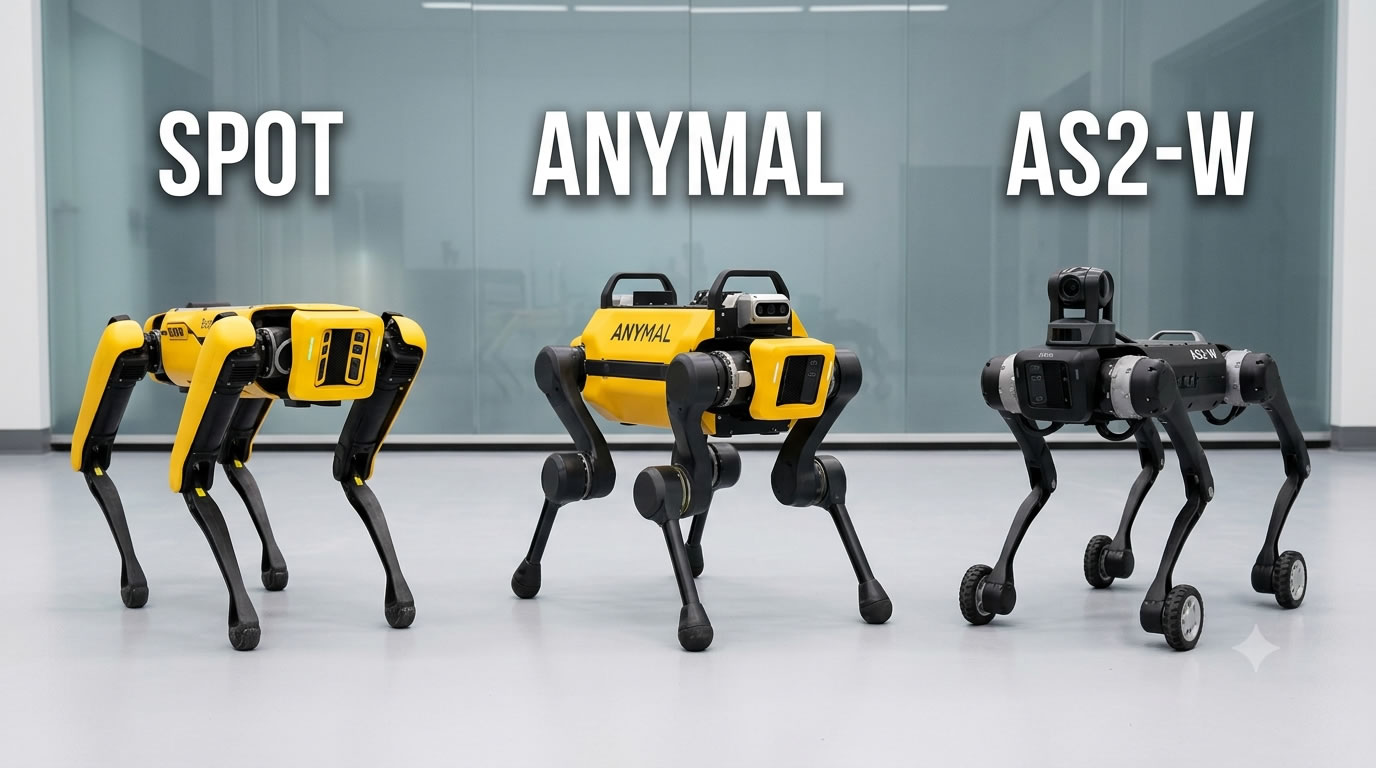
ANYbotics’ ANYmal, another leading quadruped, has been widely adopted for industrial inspection, especially in energy and processing facilities. ANYmal also relies on legs alone for mobility. Its capabilities vary by configuration, but ANYmal platforms are generally optimized for autonomous industrial inspection rather than consumer applications. ANYmal systems are typically offered through leasing or service models rather than direct purchase.
The AS2-W takes a different route. Its wheeled-leg configuration gives it a significant speed advantage on mixed terrain, with a maximum speed of more than 6 meters per second — more than three times Spot’s top speed. With a walking payload of around 16 kilograms and a static standing load capacity of up to 150 kilograms, it offers competitive carrying capability for applications where speed and mixed-terrain mobility are priorities. Unitree has not disclosed final consumer or enterprise pricing, but the company historically positions its robots at a lower price point than Boston Dynamics or ANYbotics, making the AS2-W a potentially cost-effective option for users who need both rolling efficiency and legged adaptability.
This comparison does not mean one robot is universally better. Spot and ANYmal excel in pure legged mobility and benefit from years of field experience and mature autonomous systems. The AS2-W’s hybrid design, however, makes it especially suitable for applications where covering ground quickly and carrying heavier payloads matter — such as outdoor logistics, field research, and infrastructure inspection in semi-structured environments.
Beyond Mobility: Carrying Equipment Into the Field
Beyond mobility, payload capacity is one of the key factors determining whether a robot can move from demonstrations into practical use.
The AS2-W can support a maximum static standing load of around 150 kilograms and carry a payload of approximately 16 kilograms during continuous walking, according to Unitree’s product page.
That capability makes it suitable for transporting cameras, inspection tools, sensors, or outdoor supplies.
For hikers and field researchers, the idea is straightforward: a mobile robot could reduce the amount of equipment people need to carry over long distances.
Similar capabilities could also be valuable in industrial settings. In large facilities, energy sites, or remote infrastructure locations, robots capable of moving independently across uneven terrain could support inspection tasks and collect information from areas that are difficult or unsafe for humans to reach.
From Following Commands to Navigating the Real World
The challenge for outdoor robots is not only movement, but understanding where to go and how to get there.
The AS2-W is equipped with Unitree’s ISS 3.0 Intelligent Side-follow System, designed to provide autonomous following capability with high-precision positioning. The robot also supports additional computing modules for more advanced AI applications, as detailed in Unitree’s official documentation.
In a mountain environment, the robot does not simply follow a predefined path. It must continuously respond to changing terrain conditions — loose stones, uneven ground, slopes, and obstacles that were not part of its original route.
For outdoor robots, intelligence becomes a practical requirement rather than a research concept. Robotics researchers have long pointed out that the hardest part is not making robots walk, but making them reliable enough to operate outside controlled environments.
From Robot Shows to Real-World Applications
Unitree has become one of China’s best-known quadruped robot companies, gaining global attention through its robot dogs and later expanding into industrial robots and humanoid platforms.
The company’s previous robots were often recognized for dynamic movements and demonstrations. With AS2-W, the focus shifts toward practical mobility — moving equipment, supporting inspection, and operating in environments where traditional vehicles may not work.
The development comes as the robotics industry moves beyond demonstration-focused machines toward practical deployment.
Humanoid robots have become one of the biggest areas of investment in robotics, but quadruped and wheeled-leg robots may reach commercial applications sooner because they already solve specific mobility problems.
For many real-world tasks, a robot does not need to look like a person. It needs to move reliably, carry equipment, and operate for long periods with minimal human intervention.
Will Robot Dogs Become Outdoor Companions?
The idea of a robot joining a hiking trip still sounds futuristic. Battery limitations, cost, maintenance, and reliability remain major challenges before robots like AS2-W can become common consumer products.
But the reaction to the AS2-W video shows that public expectations around robots are changing.
People are no longer only interested in whether robots can dance, jump, or perform impressive demonstrations. They are beginning to imagine robots as practical tools that can assist with everyday activities and difficult jobs.
For Unitree, the AS2-W is more than another robot dog. It represents Unitree’s attempt to move quadruped robots from controlled demonstrations into the unpredictable environments of the real world.
Whether consumers will eventually bring robot dogs into the wilderness remains uncertain. But AS2-W shows how robot makers are increasingly designing machines for environments beyond factories and laboratories.
