


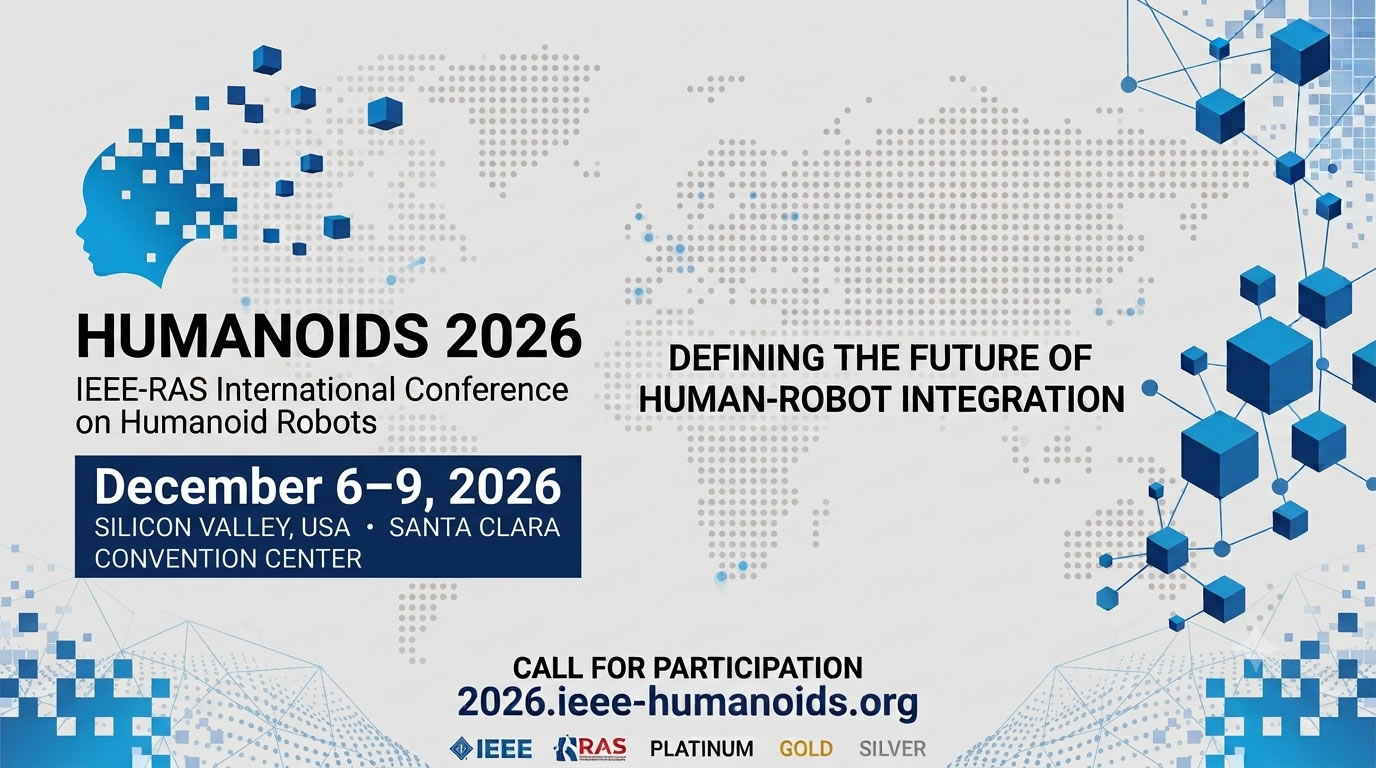
IEEE-RAS Humanoids 2026 Event Details
| Event | 2026 IEEE-RAS 25th International Conference on Humanoid Robots (Humanoids 2026) |
| Date | December 6–9, 2026 |
| Location | Santa Clara Convention Center, Santa Clara, California, USA |
| Organizer | IEEE Robotics and Automation Society (IEEE RAS) |
| Main Topics | Humanoid robots, embodied AI, robot learning, perception, control systems, and human-robot interaction |
As **humanoid robots** move from research laboratories toward real-world applications, one of the world’s most influential academic events in the field is preparing to bring together researchers, engineers, and industry leaders in Silicon Valley.
The 2026 IEEE-RAS International Conference on Humanoid Robots (Humanoids 2026) will take place from December 6 to December 9, 2026, at the Santa Clara Convention Center in Santa Clara, California, USA.
Organized by the IEEE Robotics and Automation Society (IEEE RAS), the conference marks the 25th edition of the IEEE-RAS International Conference on Humanoid Robots, one of the world’s leading events dedicated to humanoid robotics.
Unlike commercial robotics exhibitions that mainly focus on product demonstrations, Humanoids 2026 is a research-focused robotics conference covering advances in robot hardware, artificial intelligence, control systems, perception, learning, and human-robot interaction.
A Long-Running Forum for Humanoid Robot Research
The IEEE-RAS International Conference on Humanoid Robots was established in 2000 and has become one of the most recognized academic conferences focused specifically on humanoid robot technologies.
The conference is sponsored by the IEEE Robotics and Automation Society, an international organization supporting research and innovation across robotics and automation.
Over the past two decades, Humanoids has followed the evolution of the field — from early research on biped walking and mechanical design to today’s challenges involving artificial intelligence, robot learning, dexterous manipulation, and autonomous decision-making.
Key research areas covered at the conference include:
- Humanoid robot design and mechanical systems
- Robot locomotion and balance control
- Robot perception and sensor technologies
- Robot learning and artificial intelligence
- Human-robot interaction
- Cognitive robotics
- Motion planning and autonomous systems
Why Humanoids 2026 Matters for the Robotics Industry
The timing of Humanoids 2026 comes at an important stage for the global robotics industry.
For many years, humanoid robots remained mainly inside research institutions, with demonstrations focused on walking ability, balance control, and experimental tasks. Recent advances in artificial intelligence, multimodal models, and embodied AI systems are changing the direction of development.
Companies across the United States, China, Japan, South Korea, and Europe are now developing humanoid platforms for manufacturing, logistics, healthcare, retail, and service applications.
The industry discussion has moved beyond whether robots can walk like humans. Researchers and companies are increasingly focused on practical challenges:
- Can robots understand complex environments?
- Can they safely work alongside humans?
- Can they complete useful tasks reliably?
- Can humanoid robots be manufactured at commercial scale?
Conference Program and Industry Participation
Humanoids 2026 will include technical sessions, workshops, tutorials, keynote presentations, interactive demonstrations, and industry discussions.
As humanoid robots move closer to commercial deployment, collaboration between academic researchers and technology companies has become increasingly important.
Major topics expected to be discussed include:
- Embodied AI for humanoid robots
- Foundation models for robotics
- Dexterous robotic hands and manipulation
- Advanced sensing and perception systems
- Real-time robot control
- Robot safety and reliability
- Robot data collection and training methods
Silicon Valley as the Venue for the Next Humanoid Robotics Wave
Holding Humanoids 2026 in Santa Clara places the conference close to the center of global technology innovation.
Silicon Valley has become one of the most active regions for artificial intelligence and robotics development, supported by a strong ecosystem of technology companies, research institutions, semiconductor firms, and robotics startups.
The region’s combination of AI expertise and engineering talent makes it a key location for the development of next-generation humanoid robots and embodied AI systems.
Humanoids 2026 and the Future of Physical AI
The development of humanoid robots represents a broader shift in robotics — from machines designed for specific industrial tasks toward flexible systems capable of operating in human environments.
This transition is closely connected with embodied AI, where artificial intelligence is integrated with physical robots that can perceive, learn, and act in the real world.
IEEE-RAS Humanoids 2026 will provide an important view of the current state of humanoid robotics, highlighting both technological progress and the engineering challenges that remain before humanoid robots become widely adopted.
