


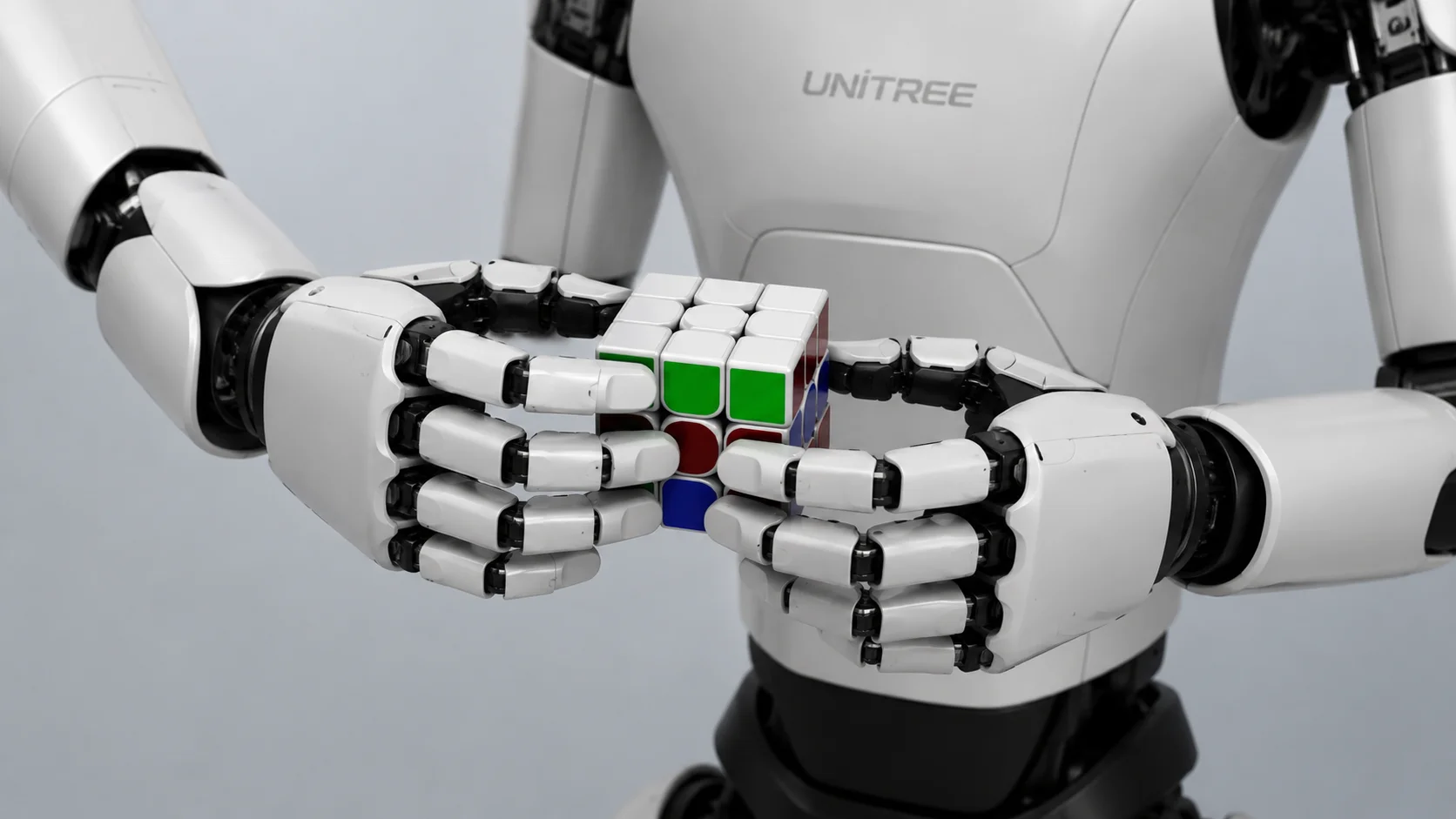
In the first quarter of 2026 alone, funding for companies working on dexterous hands reached nearly 50 billion RMB. Investment activity around firms such as Yinshi Robotics and LinkerBot has pushed what used to be lab-style hardware into a key component of the humanoid robot supply chain.
The reason behind the attention is straightforward. A robot walking up to a table only gets itself to the right place. The actual task begins when it needs to pick up a cup or twist open a bottle. That final step depends entirely on the hand.
This piece breaks down four common technical routes in dexterous hands: tendon-driven systems, linkage systems, gear or near-direct-drive systems, and screw or linear actuator-based designs.
Tendon-Driven Systems
The idea behind tendon-driven designs is simple. Motors are taken out of the fingers and moved into the palm, wrist, or even the forearm. Cables transmit force to bend and extend the fingers, similar to remote tendons.
For example, Tesla Optimus uses a design where actuators are shifted away from the fingers, relying on cable-driven transmission to move the joints.
The advantage is clear. The fingers only carry a skeletal structure and joints, which keep inertia low and allow for a high number of degrees of freedom. The hand also looks closer to a human hand in form.
The tradeoffs show up at the system level. Cables wear and stretch over time. Even small changes in routing can cause tension drift. As a result, calibration has to be repeated regularly. The real cost is not in individual parts, but in routing design, assembly consistency, and long-term maintenance.
Linkage Systems
Linkage-based designs follow a more mechanical logic. Motors drive cranks or rocker arms, which move the fingers through rigid linkages. The motion path is explicit and easy to trace.
The Linkerbot Linker Hand L20 is a representative example, using multi-link coupling to coordinate finger motion.
These systems are well-suited for repetitive tasks such as industrial sorting or fixed-position gripping. The goal is not perfect biomimicry, but stability and repeatability.
The advantage is structural simplicity. Failure points are easier to identify, and maintenance costs are more predictable. At scale, production also benefits from mature machining and injection molding processes.
The limitation comes from space and geometry. As more degrees of freedom are added, the linkage structure becomes increasingly complex. Finger design becomes harder, and the motion range is constrained by the mechanical layout.
Gear and Near-Direct-Drive Systems
The core idea here is to shorten the transmission chain. Motors are placed as close as possible to the joints, using gears or low-backlash reducers to output torque directly.
This approach makes control more transparent. The relationship between motor current, torque, and external contact becomes more direct, which improves force control.
The Allegro Hand has long been used as a research platform for this reason. Each joint can be controlled independently with high precision, making it suitable for experimentation.
The advantage lies in data quality and response speed. It works well for imitation learning, tactile feedback, and high-precision manipulation.
The tradeoff is integration pressure. Every joint needs a motor, reducer, encoder, and driver packed into a small space. Heat dissipation and overall hand volume quickly become constraints. Higher hardware density also increases system engineering complexity.
Screw and Linear Actuator Systems
This approach converts rotational motion into linear motion. A motor drives a screw, which pushes a slider to bend the finger joints.
The SCHUNK SVH anthropomorphic hand is a typical example of this architecture.
The focus here is stable delivery. The relationship between force and displacement is clear, making it suitable for standard grasping, gesture control, and light industrial tasks.
The advantage is modularity. Actuators can be replaced like standard components, and system boundaries are clearly defined.
The limitation comes from the screw mechanism itself. Friction reduces efficiency, and backdrivability is limited. When scaling to higher degrees of freedom, internal space pressure inside the hand increases quickly.
Putting the Four Approaches Together
Tendon-driven systems prioritize lightweight design. Linkage systems focus on engineering stability. Gear and near-direct-drive systems aim for control performance. Screw-based systems emphasize delivery reliability.
These are not rankings. They represent different sets of tradeoffs.
Higher freedom and lighter hands require accepting maintenance challenges from cable systems. Stable mass production requires accepting structural constraints. Strong force control demands higher hardware density. Fast deployment often comes with limited performance.
In the near term, dexterous hands will not converge into a single design path. The real competition is shifting toward three questions: whether modules can be replaced quickly, whether contact feedback can be closed into a reliable loop, and whether each unit can perform consistently at scale.
As these problems are gradually solved, dexterous hands will move beyond structures that only resemble human hands and become end effectors capable of operating reliably in complex real-world environments.
