


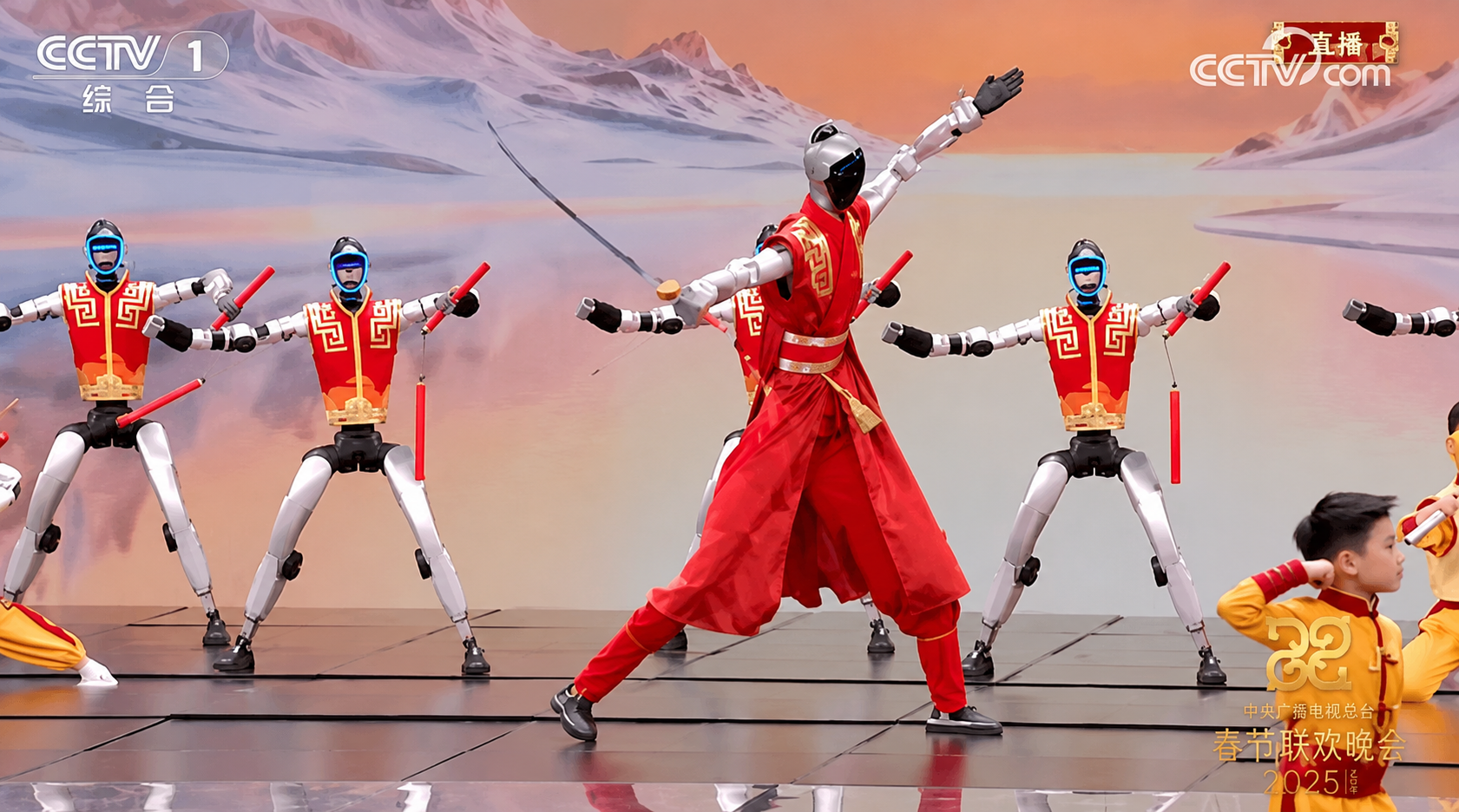
When China’s kung fu humanoid robots appeared on the 2026 Spring Festival Gala, they quickly drew attention across social media. They backflipped, tumbled, moved with human dancers, and performed with nunchucks and staffs on stage.
That raised a simple question: are these kung fu robots humanoid robots, smart robots, or examples of Embodied AI? Are these terms just different names for robotics, or do they refer to different concepts?
This article explains the differences between Embodied AI, smart robots, and humanoid robots, and shows how they relate to each other.
What Is Embodied AI?
Embodied AI refers to artificial intelligence that can operate in the real world through a physical body. It can sense its environment, make decisions, and take action through that body.
Humanoid robots, robotic arms, delivery robots, drones, and even self-driving cars can all be considered forms of Embodied AI when they use AI to perceive, decide, act, and respond to the physical world.
The key idea is embodiment. Intelligence has to be connected to a body, and that body has to interact with the real world.
For example, a robot sees an object on a table, identifies its position, plans an arm movement, touches the object, feels resistance, and adjusts its grip. This loop of sensing, decision-making, action, and feedback is what separates Embodied AI from traditional AI systems that mainly process text, images, or data without acting physically.
What Is a Smart Robot?
A smart robot is a robot with sensing, computing, control, and action capabilities. It is first a physical machine and a hardware system. It usually includes mechanical structures, sensors, controllers, actuators, and software systems.
Smart robots can perform tasks such as cleaning, delivery, inspection, goods handling, picking, and assembly.
Compared with Embodied AI, a smart robot is closer to a product category. Embodied AI focuses on how intelligence interacts with the environment through a body. A smart robot focuses on the machine that carries that capability and completes real tasks.
For example, a robot vacuum can detect obstacles and plan a cleaning route. A delivery robot can avoid pedestrians inside a building and bring items to a designated location. An industrial robotic arm can identify the position of a part and complete picking or assembly tasks.
These are all smart robots. They do not need to look human, but they all have some level of sensing and action capability.
The relationship between smart robots and Embodied AI can be understood as a relationship between carrier and capability. Embodied AI can become one of the core capabilities inside a smart robot, while smart robots are one of the most common physical carriers for that capability.
A robot can start as a basic smart robot. At a more advanced stage, it can become a smart robot powered by Embodied AI.
What Is a Humanoid Robot?
A humanoid robot is a robot with a body shape and structure similar to a human. It usually has a head, torso, two arms, and two legs. Some humanoid robots also include dexterous hands, vision systems, and voice interaction capabilities.
Compared with a smart robot, the key feature of a humanoid robot is its human-like form.
The value of a humanoid structure is that it can more easily enter environments already built for people. Factory workstations, warehouse shelves, office door handles, household furniture, and stairs are all designed around human body size and movement.
If a robot has a body structure close to ours, it can theoretically use the same tools, move through the same spaces, and take on more tasks originally done by humans.
Tesla Optimus, Figure robots, Unitree G1, and UBTECH Walker are all examples of humanoid robots.
A humanoid robot can also be a type of smart robot. In simple terms, humanoid robots fall under the broader category of smart robots.
Embodied AI vs. Smart Robot vs. Humanoid Robot
When these three terms are placed side by side, the difference becomes much clearer. Embodied AI is about intelligence. Smart robot is about the robot as a product. Humanoid robot is about the robot’s body form.
| Term | Main Focus | What It Means | Example |
|---|---|---|---|
| Embodied AI | Intelligence capability | AI senses the environment, makes decisions, and acts in the physical world through a body. | A robot that adjusts its grip based on object position and force feedback. |
| Smart Robot | Product category | A robot with sensing, computing, control, and action capabilities. | Robot vacuums, delivery robots, robotic arms, inspection robots. |
| Humanoid Robot | Body form | A robot with a human-like shape and structure. | Tesla Optimus, Figure robots, Unitree G1, UBTECH Walker. |
So, What Are the Kung Fu Robots?
Now let’s return to the kung fu robots on the Spring Festival Gala stage. They performed complex physical movements in front of a live audience, including tumbling, backflips, synchronized dancing, and martial arts-style actions.
From their body shape, they can be described as humanoid robots. If they include sensing, control, and movement systems, they can also be considered smart robots.
To decide whether they are truly examples of Embodied AI, we need to look deeper. Can they understand the live environment? Can they adjust their movements when something changes? Can they build a real-time feedback loop between their bodies and the outside world?
If they are mainly following a preset program, they are better described as a humanoid robot performance. If they can perceive, decide, and actively adjust through their bodies, then they are much closer to Embodied AI.
Conclusion
Embodied AI, smart robots, and humanoid robots are connected, but they do not mean the same thing.
Embodied AI explains how intelligence enters the physical world. Smart robots describe machines that can sense, compute, control, and act. Humanoid robots describe robots built with a human-like body structure.
A humanoid robot can be a smart robot. When all three come together, the result is a robot that has a human-like body, task-performing capability, and physical intelligence that can respond to the real world.
