


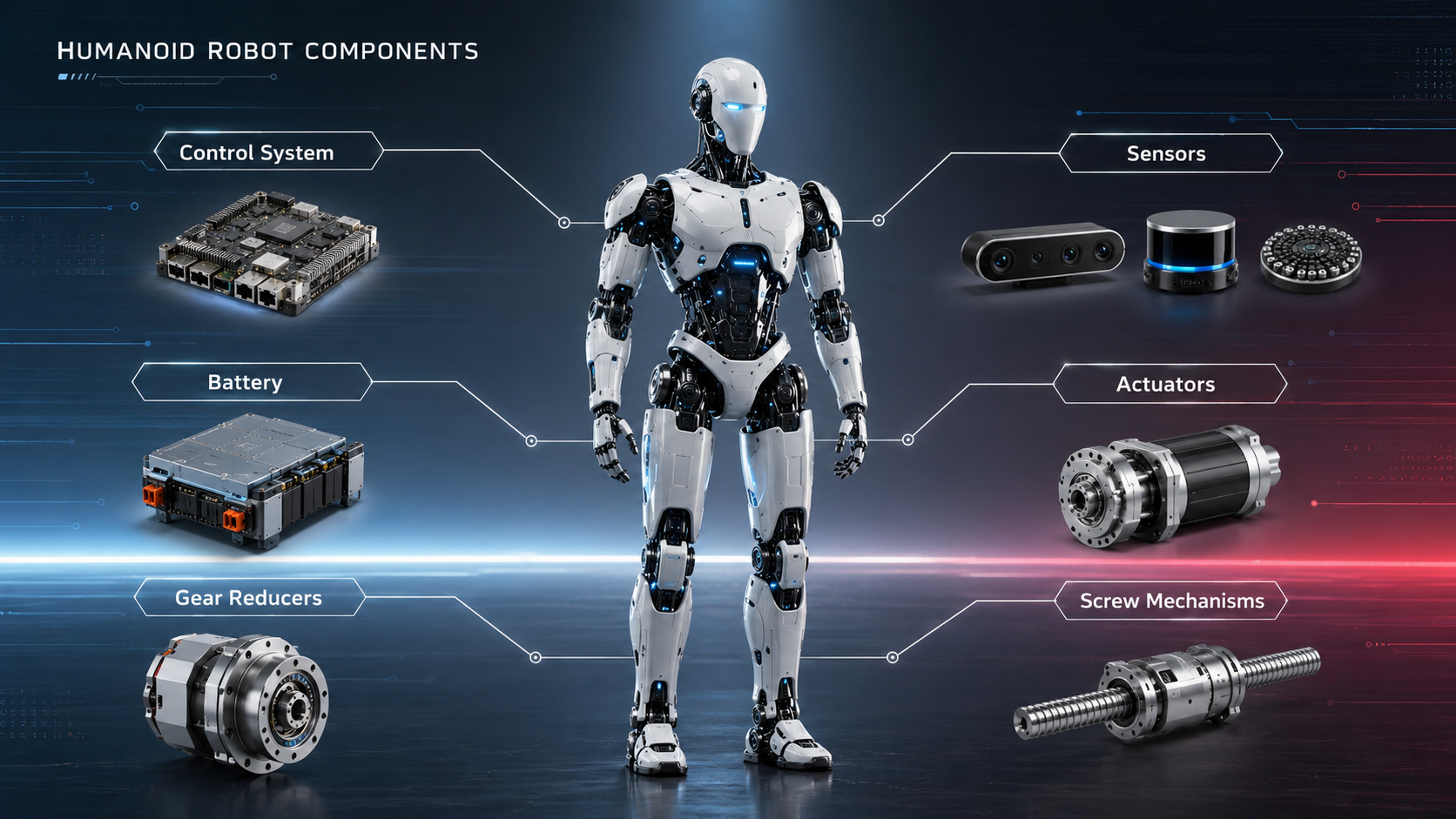
Humanoid robots are designed in human form for a practical reason: the physical world is built for human movement, tools, and environments. Inside the system, their structure is relatively straightforward, built around mechanical, electrical, and computational layers that work together.
A humanoid robot typically combines a mechanical skeleton, motor-driven actuators, a central control system, and multiple layers of sensors that function like vision and touch. These components allow the robot to move, perceive, and respond to its environment.
Key Components of a Humanoid Robot
1. Servo motors and actuators
The foundation of movement in a humanoid robot comes from servomotors and actuators. These systems convert electrical energy into mechanical motion, producing rotation or linear movement across joints.
Modern actuators often integrate sensors and control units, allowing real-time feedback. This means the system continuously adjusts its position during motion rather than following a single fixed command.
2. Gear reducers
Gear reducers are responsible for converting speed into torque. High-speed motor rotation is slowed down while force output is increased through mechanical transmission systems.
Different joints require different reducer types. Harmonic reducers are used in smaller, precise joints such as wrists and fingers, while RV reducers are applied in load-bearing joints like hips and shoulders due to their higher strength and durability.
3. Sensors: perception systems
Sensors allow humanoid robots to understand their environment. Vision sensors capture images and depth information, enabling spatial awareness.
Force and tactile sensors help control grip strength, preventing objects from slipping or being crushed. Meanwhile, gyroscopes and accelerometers measure balance, orientation, and motion states.
4. Screw mechanisms
Screw mechanisms convert rotational motion into linear movement. As the screw rotates, the nut moves along its thread, producing controlled pushing or pulling actions.
Common types include ball screws and roller screws, which provide high precision and low friction. Trapezoidal screws are simpler and more cost-efficient but less precise.
5. Battery systems
Energy supply in humanoid robots relies on advanced battery systems. Lithium-ion batteries are widely used due to their high energy density, while lithium iron phosphate (LFP) batteries offer improved safety and longer lifespan.
A battery management system (BMS) monitors charging, discharging, and temperature conditions to ensure stable and safe operation.
6. Control system
The control system functions as the decision-making layer of a humanoid robot. It processes sensor data, runs algorithms, and sends commands to motors and actuators in real time.
With advances in deep learning and reinforcement learning, modern humanoid robots can adapt to environments and improve interaction quality through experience.
Humanoid Robot Supply Chain in China
Behind these systems is a rapidly expanding industrial ecosystem. China’s humanoid robot supply chain is closely connected to industries such as electric vehicles, industrial automation, and consumer electronics.
Companies like Leaderdrive and Shuanghuan Transmission produce key components such as precision reducers. These systems provide the mechanical foundation for joint movement and load handling.
For motion control, companies such as Inovance Technology and Moons’ Industries supply servo motors and drive systems that regulate joint movement.
In sensing technologies, firms like Keli Sensing, Donghua Testing, and Hesai Technology contribute force measurement, testing systems, and perception technologies originally developed for autonomous driving.
Energy systems are largely supported by major battery manufacturers such as CATL and BYD, which already operate at large scale within the electric vehicle industry.
This ecosystem matters not because of individual companies, but because most of the supply chain already exists at industrial scale, enabling faster production and integration of humanoid robots.
From Components to Integrated Systems
Most humanoid robots are not built from entirely new technologies. Instead, they are assembled from existing components such as motors, sensors, reducers, batteries, and controllers already used in other industries.
The difference lies in system integration. These components are combined into a coordinated structure that allows perception, movement, and decision-making to function as a unified system.
Humanoid robots are evolving from isolated prototypes into practical systems built on mature industrial technologies, gradually moving closer to real-world deployment.
