


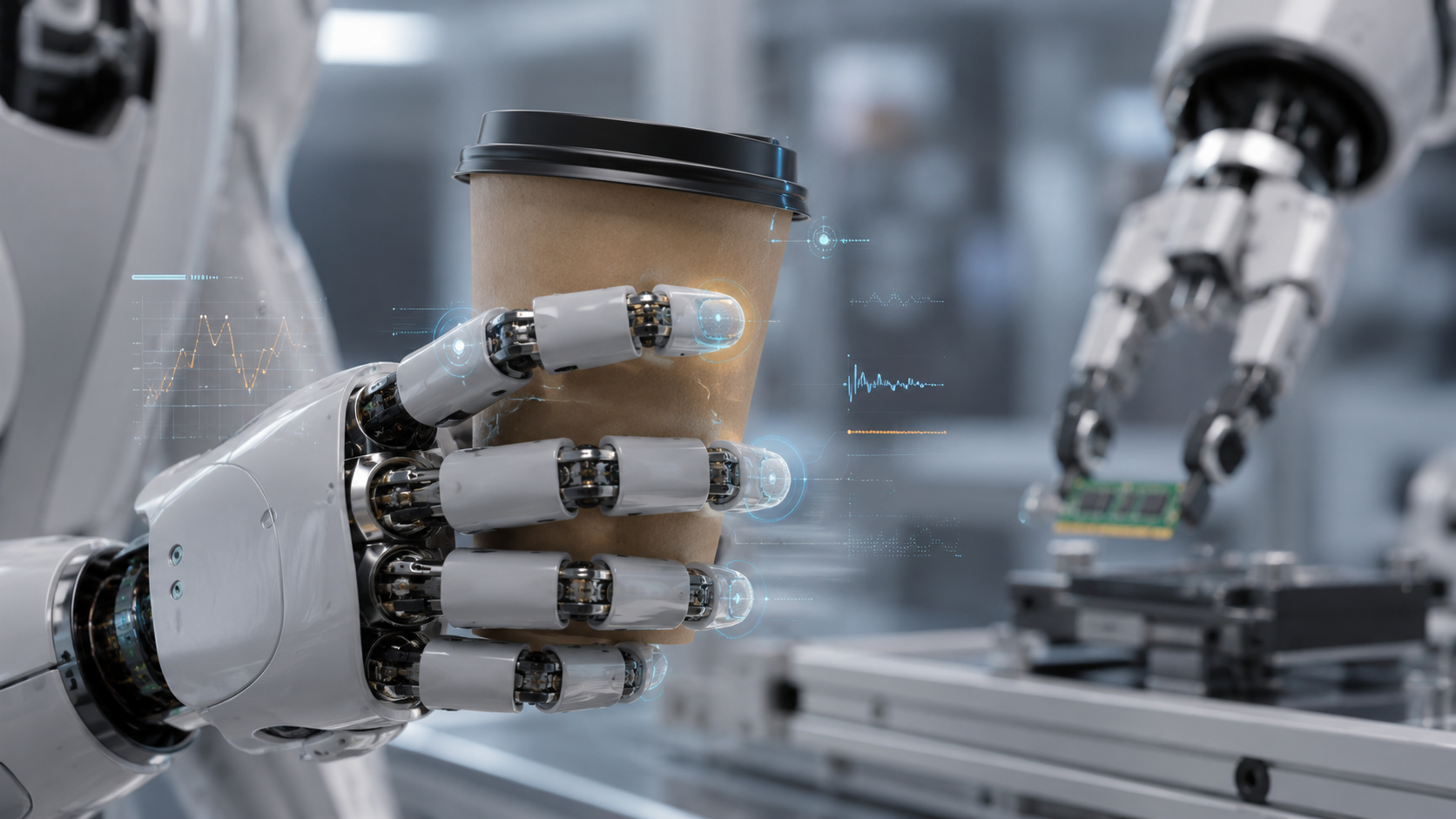
Try picking up a paper cup full of coffee. You probably don’t think about how much pressure you’re applying with your fingers. You just adjust naturally, without even noticing. But for a robot, even holding that cup without spilling or crushing it is a real challenge. Grip too loosely, and the cup slips. Grip too tightly, and the lid might pop off, or the cup might collapse.
This is one of the practical problems that embodied AI still needs to solve. Cameras and vision models can identify an object and locate it, but vision alone isn’t enough once the robot makes physical contact. Once contact happens, the robot has a new problem to solve: is it pressing too hard, is the object slipping, or should the grip change?
How Robot Tactile Sensors Work
Depending on the application and how complex the task is, a humanoid robot might use anywhere from 30 to 200 sensors.
Most of these sensors are placed on the fingertips, gripper pads, wrists, or end effectors. When the robot makes contact, the tactile sensor detects pressure, contact position, vibration, slip, and sometimes how the surface deforms. That data goes back to the control system, which then decides what to do next: tighten the grip, reduce force, adjust the angle, or simply stop before breaking something.
Raw tactile data is only the starting point. A sudden pressure rise might mean the part has clicked into place, or it could mean the part is jammed, crooked, or slipping. Like a human, the robot needs repeated experience to tell those cases apart.
Why Touch Matters in Robot Assembly
Take a simple assembly task. A camera can guide a robot hand toward a slot, but once the part touches the edge, vision alone often cannot tell what’s going wrong. If the angle is slightly off, pushing harder might just bend the part or damage the connector. With tactile feedback, the robot can notice the resistance, back off, adjust the angle, and try again.
That’s the real goal: not just feeling touch, but interpreting it.
Xense Robotics: Building Tactile Sensors for Real Robot Manipulation
Xense Robotics, founded in Shanghai in May 2024, focuses on multimodal tactile sensing and dexterous robot manipulation.
Xense’s G1-WS tactile sensor is integrated into the robot gripper. In a task like inserting a memory module into a motherboard, the sensor helps the gripper read force, contact position, and slip in real time. When the module first touches the connector, the robot can tell whether the pressure is even or if one side is encountering resistance. If the alignment is off, it can make small adjustments in angle and force before pushing further. Once the module is properly seated, the contact pattern stabilizes, helping the robot confirm that the insertion is complete.
G1-WS Tactile Sensor in Precision Assembly
According to GeekPark, Xense’s G1-WS has been used in AgiBot’s data collection work across precision assembly, industrial manufacturing, and smart service scenarios. One example is installing a memory module inside a computer chassis, a task that requires careful alignment and force control. In that task, the camera can get the robot close to the slot. But the final judgment comes from contact: is the module sitting flat, or is one side pushing against the connector?
Xense Robotics at ICRA 2026
At ICRA 2026, Xense showed how tactile feedback could support longer, two-arm manipulation tasks. Its demo used VTLA model-driven tactile intelligence and a data collection device called TacCap-Gripper. It handled highly deformable cardboard while dealing with continuous external disturbance during contact, and still completed a sequence of actions including grasping, unfolding, folding the edges, and pressing the material into shape to form the box.
Xense also showed several tactile sensor products at the event, including sensors for fingertips, grippers, full-hand sensing, and larger contact surfaces. These products are aimed at different robot platforms, including dexterous hands, industrial arms, humanoid robots, embodied AI systems, and flexible interaction devices.
Why Tactile Sensors Matter for Humanoid Robots
Vision helps a robot see its surroundings, but touch gives it feedback from direct contact. It tells the robot how much force is being applied, how a material is deforming, whether something is starting to slip, and where resistance is changing.
Xense Robotics is working across several parts of the tactile sensing stack: sensor hardware, data collection devices, tactile world models, and VTLA-based applications. Together, they show why robot tactile sensors may become an important foundation for embodied AI as robots move from lab demos into real-world tasks.
