


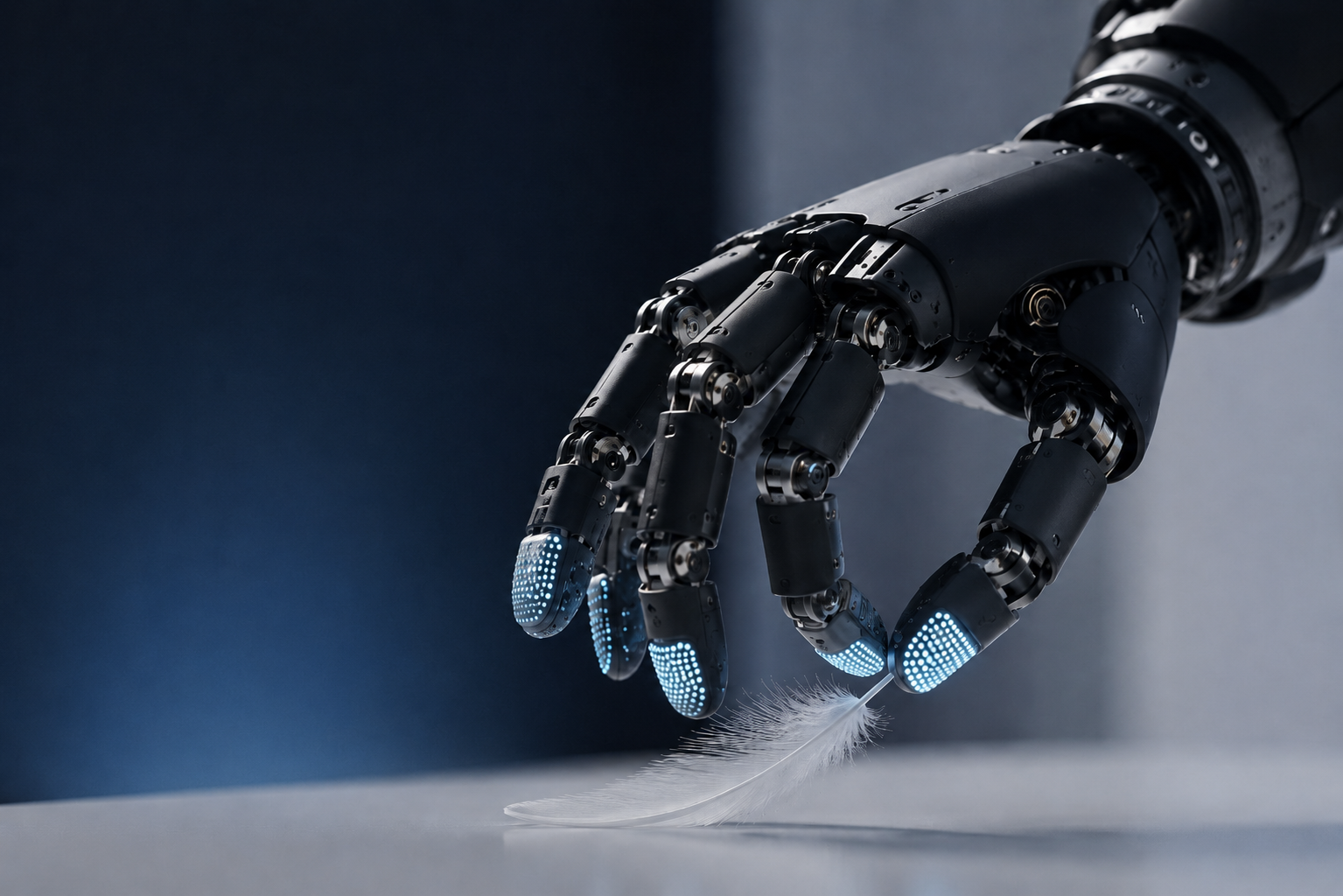
For years, dexterous hands were considered auxiliary devices for robots. For basic gripping tasks, a robot could often rely on a simple gripper, clamp, or standard end effector.
At ICRA 2026, multiple Chinese manufacturers displayed innovations in next-generation dexterous hands, mainly in degrees of freedom, tactile sensors, drive units, payload, and data acquisition.
Today, the focus is no longer whether a dexterous hand can open, close, and grip objects. The harder challenge is whether it can detect contact, adjust force, handle delicate objects, and record useful interaction data during real tasks.
Wuji Hand 2: Lightweight Direct Drive With Full Tactile Sensing
Wuji Technology demonstrated Wuji Hand 2 at ICRA 2026. It is a bionic dexterous hand with 20 degrees of freedom and a fully direct-drive mechanism. The hand weighs less than 570 grams and can provide 12 kilograms of static gripping force.
The hand uses flexible tactile arrays on the fingertips and finger pads. Compared with the previous model, Wuji Hand 2 improves backdrivability, stability, and manipulation performance.
Its main features are lightweight construction, a direct-drive system, full tactile sensing, and strong gripping capability.
Xynova Flex 2: Tendon Drive and Direct Drive in One Hand
Xynova introduced Flex 2, a dexterous hand that combines tendon drive and direct drive. Flex 2 has 23 degrees of freedom, including 19 active DoF and four passive DoF. The palm itself weighs under 400 grams.
The tendon-drive system handles finger bending and gripping. Larger motors are placed in the forearm to reduce the load on the hand and limit heat buildup during long use. Smaller movements, including lateral finger motion and thumb opposition, are handled by direct-drive motors inside the palm.
Flex 2 also includes a wrist-mounted camera, 3D tactile sensors on the fingertips, palm proximity sensors, and force sensors. At ICRA, it performed tasks such as scooping popcorn and writing lines.
TARS DexHand: Human-Scale Design for Embodied Data Collection
TARS DexHand is a 21-DoF dexterous hand built at a 1:1 human-hand scale. Its design places particular attention on the thumb and multi-axis finger motion.
Instead of using a tendon-drive mechanism, DexHand relies on a rigid quasi-direct-drive architecture. At ICRA 2026, its capabilities were shown through sign-language letters, mirrored hand gestures, and wire harness assembly.
The product is positioned as part of a larger hand-control and embodied-data system, covering tactile prediction, model training, and manipulation data collection.
OmniHand 3 Ultra-M: Direct Drive, Dense Tactile Sensing, and Balloon Folding
The OmniHand team introduced OmniHand 3 Ultra-M, a complete direct-drive dexterous hand with more than 20 degrees of freedom in a human-hand-sized design. The palm and fingertips contain more than 300 3D tactile sensing points.
The fingertip sensor system can recognize contact location, pressure distribution, deformation, and slip signals.
What drew more attention at ICRA was OmniHand’s demo of a dexterous hand folding a balloon dog. It may look simple, but balloons are slippery, easy to pop, and constantly changing shape as they are twisted and folded. The hand has to feel what is happening in real time, adjust pressure, and decide when to hold or twist.
Sharpa Wave: Tactile Five-Finger Hand for Humanoid Robot Platforms
Sharpa Wave had already drawn attention at CES with its autonomous card-dealing demo, which showed the hand dealing cards without human intervention.
At ICRA 2026, Sharpa North appeared again with Sharpa Wave. On-site, the robotic system dealt Blackjack cards and distributed gift bags through teleoperation, adapting to the pace of the performance and audience reaction.
Sharpa Wave has also been integrated into NVIDIA’s Isaac GR00T Reference Humanoid Robot, which combines Unitree’s H2 Plus humanoid robot with Sharpa Wave tactile five-finger hands. This gives Sharpa Wave a more visible role in next-generation humanoid robot platforms.
PaXini PXCap V: Capturing Human Hand Data for Robot Learning
At ICRA, PaXini showed PXCap V, a five-finger data collection glove. It is not a robot hand for directly grasping objects. Instead, it is used to collect human hand operation data, especially tactile feedback, finger posture, and fine manipulation trajectories.
PXCap V has 82 degrees of freedom, 30 six-dimensional tactile modules, and 3,015 tactile points. It can record contact, force, joint movement, and trajectory changes across the whole hand during operation, helping robots learn how humans grasp, press, adjust, and move objects.
The value of this kind of device is that it captures what video data cannot show. Besides PXCap V, PaXini also displayed the PX-6AX-GEN3 tactile sensor, the DexH13 dexterous hand, and the TORA-DOUBLE ONE humanoid robot.
Linker Hand O20 and O30: High Load, Fast Actuation, and Self-Locking Grip
Linker Hand launched two new dexterous hands, O20 and O30, at ICRA 2026. O20 features 16 fully actuated degrees of freedom and uses brushless coreless motors and worm gear joint modules. It has a 20 kg rated load capacity and can fully open or close in 0.8 seconds.
The advantage of O20 lies in its combination of fast actuation and stable gripping. Because of its worm gear mechanism, O20 has self-locking capability. After grasping an object, it only needs 0.45A of static current to hold position.
That makes it more useful for repetitive gripping, stable handling, and long-duration operation.
O30 builds on O20 by increasing the number of fully actuated DoF from 16 to 20. It is designed for complex manipulation tasks, algorithm development, and reinforcement learning.
APEX HAND: Hybrid Drive With Internal Motors and Modular Fingers
YuanSheng Intelligence showcased its APEX HAND dexterous hand at ICRA 2026. The product has 21 degrees of freedom, including 16 active DoF and five passive DoF. It uses a hybrid drive system that combines tendons, motors, and linkages.
APEX HAND uses a redesigned tendon routing system. Its tendons no longer pass through the wrist area, which helps reduce dry friction at the wrist from the mechanical structure itself.
At ICRA, APEX HAND demonstrated hammering nails with a handheld hammer, a 10 kg single-hand grip, and a maximum lifting capacity of 30 kg.
APEX HAND adopts an “arm-hand separation + fully internal motor” design. All drive motors are integrated inside the palm, and each finger is built as an independent module for easier replacement and maintenance.
For robot makers and algorithm teams, it works more like a standardized dexterous hand module that can be quickly adapted to different robotic arms and humanoid platforms.
Dexterous Hands Move Closer to Embodied AI
At this year’s ICRA, dexterous hands were clearly one of the busiest product categories.
Some companies focused on higher degrees of freedom. Some pushed tactile sensing further. Others worked on stronger payload, longer runtime, or easier data collection.
Dexterous hands are no longer just add-on end effectors. They are becoming a direct interface for embodied AI, vision-tactile perception, and real-world manipulation.
Which direction in dexterous hand development are you watching most closely?
