


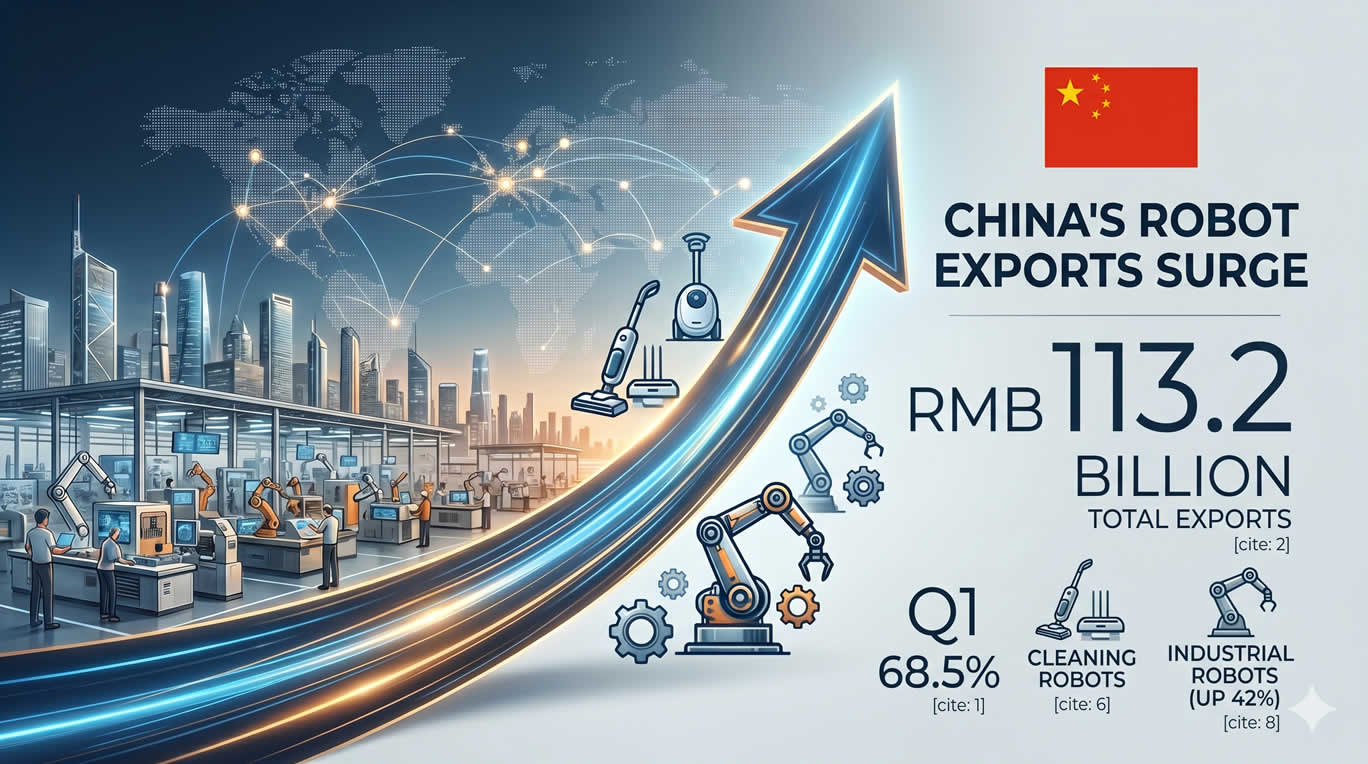
For a long time, the global image of Chinese manufacturing has been stuck on labor-intensive, low-cost assembly. Fresh customs data is now rewriting that story. In the first quarter of 2026, China exported a total of RMB 11.32 billion (approx. US$1.6 billion) worth of robots, reaching 148 countries and regions.
For anyone tracking technology and global business, these numbers send a clear signal: China’s robotics sector is moving beyond contract manufacturing and low-price volume plays, and has entered a decisive phase of exporting technology and brands to the world.
Reshaping the consumer market: more than robot vacuums, now AI endpoints
Cleaning robots dominated the export mix in Q1. According to figures tied to newly created customs codes, the category generated RMB 7.75 billion in exports, accounting for 68.5% of the total.
Look closer at how these products are performing in North America, Europe and Southeast Asia, and it becomes clear the gains are not built on price wars. What gives Chinese brands their strong position in the global home-cleaning market is a combination of mature technology and mature application scenarios. Most mainstream export models now come standard with lidar navigation, AI-powered dynamic obstacle avoidance and multi-robot coordination. By embedding artificial intelligence, the devices can build home maps, recognize moving obstacles and even predict behavior, moving the user experience from “basically usable” to intelligent and genuinely helpful.
Industrial automation spillover: filling the gaps in a shifting supply chain
Outside the consumer space, industrial robots are also showing strong momentum. Exports of industrial robots hit RMB 3.16 billion, a 42% jump year-on-year, with both volume and average unit prices rising.
This growth is closely tied to the restructuring of global supply chains and the broader macro environment. As some manufacturing capacity shifts to Southeast Asia and Mexico, and as the clean-energy supply chain expands rapidly worldwide, demand for welding, handling and assembly automation is experiencing a structural surge. Chinese manufacturers, with their strong price-performance ratios, short delivery times and responsive service, have moved quickly to capture market share in these emerging and transitioning markets.
What’s powering the global push
Two forces stand out.
First, a largely self-sufficient and vertically integrated supply chain. China has steadily raised the localization rate of core components — reducers, servo motors, controllers and lidar. This dense supplier network translates into shorter lead times and, at comparable performance levels, a notable cost advantage over overseas competitors.
Second, the business model has shifted in a fundamental way. Chinese robotics companies are no longer merely exporting standalone machines. They are now offering full solutions that cover equipment, deployment, maintenance and custom development. By building local service centers, setting up joint R&D operations and experimenting with leasing and robotics-as-a-service models, they are establishing more durable, relationship-driven ties with international customers.
From a supply-chain link to a solutions brain
RMB 11.32 billion in quarterly exports is more than a financial milestone — it captures the changing role of China’s tech manufacturing in the global division of labor. In cleaning robots, continuous technology iteration has given Chinese brands a dominant position. In industrial robots, the country has flipped from being a net importer to a net exporter, securing solid footholds in high-end segments such as renewable energy and 3C manufacturing.
With embodied intelligence, industrial foundation models and humanoid robots steadily moving from the lab into real-world applications, the next acceleration phase of China’s robotics exports is already taking shape. For the rest of the world, China is no longer just a node in the supply chain. It is turning into a direct provider of intelligent solutions. This strong Q1 opening may be only the beginning of a long, steep growth curve.
