

A composite ranking of ten listed Chinese suppliers — depth cameras, motion capture, teleop rigs, collection farms — and what their margins say about who actually gets paid for teaching machines to move.
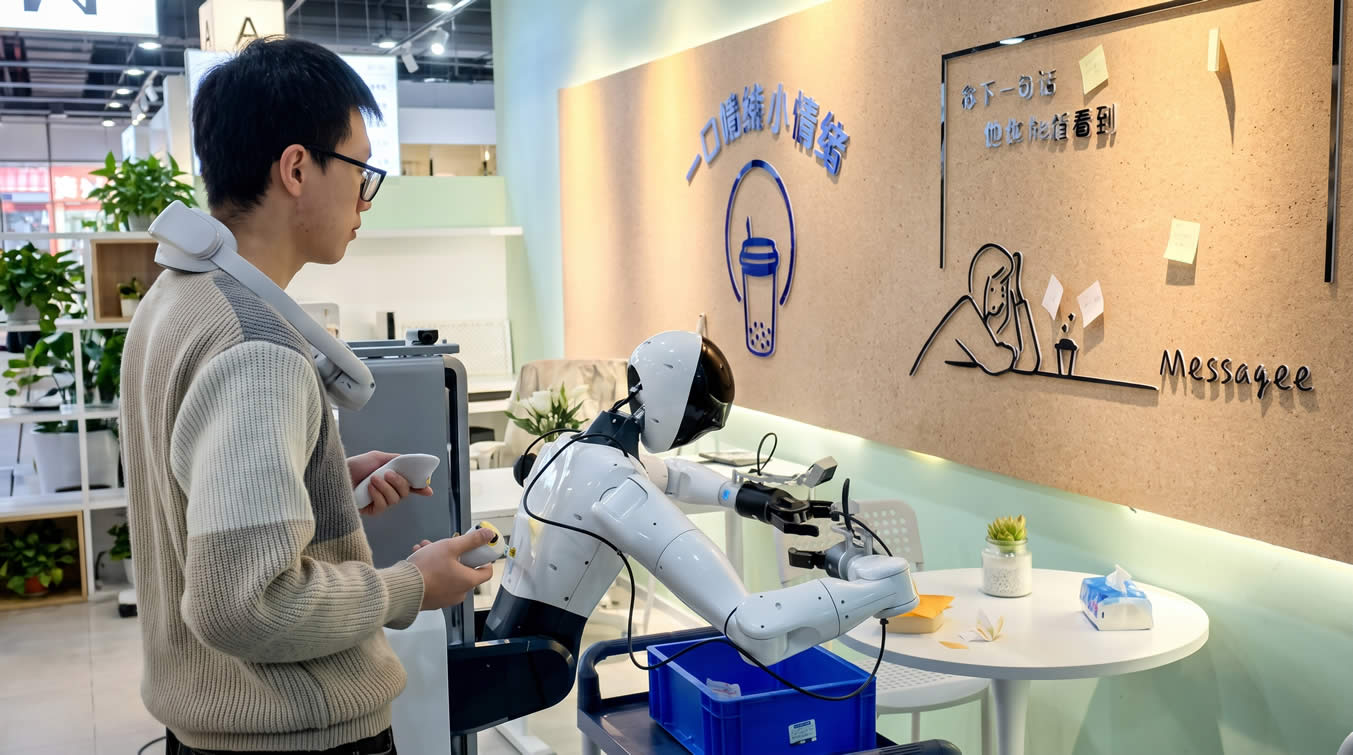
SHANGHAI — The work looks like rehearsal for a play that never opens. A worker in a VR headset stands at a counter, picks up a paper cup, sets it down, picks it up again. Half a second behind, a humanoid robot copies the angle of the wrist, the pressure in the fingers, the small pause before the grip closes.
AgiBot’s data collection center in Pudong is just over 4,000 square meters of this: mocked-up kitchens, supermarket counters, factory benches, a hundred-odd robots and shifts of people whose job is to repeat themselves. The place turns out somewhere between 30,000 and 50,000 episodes a day (single recorded demonstrations, most of them a few seconds long) and has banked more than a million since it opened in September 2024.
That is what a data center looks like when the data is physical.
Nobody wrote any of this down
A language model can be trained on text that already exists. Other people wrote the books, the forum threads, the source code. A robot policy needs something different: what a hand does, in what order, with how much force, in response to what the camera saw. Public datasets of that exist, and some are large by the standards of a research lab. None of them is the equivalent of the web — a sprawling, messy, naturally occurring record of people doing ordinary things. That record has to be performed.
Simulation fills part of the gap, and only part. Simulated kitchens have obedient physics. Objects in them do not deform in unexpected ways, floors do not tilt, sunlight does not arrive through a window at the wrong angle. Engineers call the difference the sim-to-real gap, and the standard workaround is to pretrain in simulation and then correct with real demonstrations. The correction is the expensive half.
The cost is starting to show up in order books. Brokerage research puts data collection at roughly 31% of humanoid robot orders in 2025, with more than half expected this year — an estimate, not a census, but one that points the same way as everything else in this market. The fastest-growing thing Chinese robot makers are selling right now is not arms or legs. It is the act of teaching.
The same brokerage tally counts 15 to 20 collection centers across the country, most running 100 to 200 robots each. AgiBot’s Pudong site is the best known and will not be the largest for long.
Four ways to get a demonstration
Teleoperation is the most faithful and the least scalable. A human drives the robot through a task, often with a headset and hand controllers, and the machine records joint angles, forces, trajectories, camera frames, all of it time-stamped together. One operator, one robot, one task at a time. The scarce input is not hardware. It is the operator’s attention, and attention does not depreciate well.
Robot-free capture trades fidelity for throughput. Gloves, headsets, handheld grippers: the operator demonstrates with a sensor rig instead of a machine. It is cheaper and it scales faster, but what you have recorded is a human hand, and a human hand has to be retargeted onto a robot with different kinematics and a different reach. Something is always lost in translation.
Simulation costs almost nothing per episode and can generate variation no physical set could hold. It also accumulates a fidelity debt that has to be paid off in the real world.
The fourth source is the cheapest and the messiest: robots already working on factory floors generate logs whether anyone asks them to or not. The logs are unlabeled, the tasks are narrow, and the whole thing depends on somebody else having bought the robot first.
Most serious pipelines mix all four. The mixing ratio is the trade secret.
The ranking
The table below comes from a Chinese financial ranking that scores listed suppliers on growth and profitability together: revenue growth, adjusted net profit growth, operating cash flow growth, then return on equity, gross margin and net margin. The source does not publish the weights behind its composite, and every figure is company-wide — Longcheer’s revenue is mostly phones, Leyard’s mostly LED screens. Read it as a map of business models rather than a league table of robot-data divisions. It puts Longcheer first and Frontop last.
| # | Company | What it sells | Rev. YoY | Adj. NP YoY | OCF YoY | ROE | Gross margin | Net margin |
|---|---|---|---|---|---|---|---|---|
| 1 | Longcheer | Capture hardware JDM/ODM | −9.18% | −15.91% | 10.85% | 10.35% | 8.78% | 1.40% |
| 2 | Orbbec | RGB-D depth sensing | 66.66% | 163.16% | 195.81% | 4.37% | 43.76% | 13.57% |
| 3 | OPT Machine Vision | Vision hardware, dataset co-build | 39.24% | 32.78% | 1,623.62% | 6.22% | 60.86% | 15.11% |
| 4 | LUSTER LightTech | FZMotion optical mocap | 30.35% | 86.05% | −23.15% | 3.95% | 34.79% | 5.54% |
| 5 | Speechocean | Multimodal data services | 59.00% | 116.85% | −93.83% | 1.90% | 48.08% | 4.00% |
| 6 | PIA Automation | Industrial capture, ego devices | −3.83% | 137.26% | −40.79% | 0.68% | 21.95% | 0.46% |
| 7 | Shijihengtong | Egocentric capture services | −12.45% | n.m. | n.m. | −2.97% | 20.23% | −3.75% |
| 8 | Cocyber | Collection center operations | 24.51% | n.m. | 482.34% | 0.26% | 22.14% | 0.18% |
| 9 | Leyard | OptiTrack optical mocap | −1.20% | 125.23% | 59.59% | 3.73% | 31.41% | 4.72% |
| 10 | Frontop | Robot-free capture, AI 3D | 72.81% | n.m. | 126.02% | −18.08% | 23.48% | −21.02% |
The top of that list is the least exciting company on it, which tells you something about what the ranking is actually measuring. Longcheer has been shrinking. Revenue fell 9.18% year on year, adjusted profit fell 15.91%, and the company keeps 8.78 cents of gross profit on every dollar of sales — the thinnest margin in the sample by a wide margin. Whatever weights the composite uses, they reward a company that turns that thin margin over fast enough to produce a 10.35% return on equity.
Longcheer is a phone and tablet ODM with 42.1 billion yuan of 2025 revenue and 585 million yuan of net profit. Its robot business is real, though. In late 2025 it placed an order worth hundreds of millions of yuan for AgiBot’s Genie G2 humanoid, with around a thousand units planned for its own production lines. Eight of them went into a tablet line in Nanchang in December, and by March they had been folded into the quality-inspection station, where the cluster has since logged close to 3,000 cumulative hours of work. Longcheer also designs and manufactures the capture rigs other companies use to gather training data. It sells the rigs and runs the floor that uses them.
Where the eyes are
Four of the ten own the sensing technology that turns a physical action into a number.
Orbbec is the most consequential. By its own accounting it took 29% of global robotics 3D vision revenue in 2025, which in a market where the top five hold 71.7% makes it the closest thing to a standard. Its Gemini 336 module ended up inside Reachy 2, the research humanoid Pollen Robotics sells into university labs, and robotics revenue more than doubled last year. Its gross margin sits above 40%, which is what a component supplier earns when the component is hard to make.
OPT Machine Vision earns more: 60.86%, the highest in the sample. Machine vision for factory automation was a good business before anyone said “embodied AI.” Its role in data collection is a side door: it supplies the vision stack, then co-builds datasets with robot platforms. The margin is real. The exposure to robot training data is thinner than the margin implies.
Leyard is the cautionary case for anyone reading a supplier list quickly. Its OptiTrack system is the reference optical motion capture setup in the field, and the 260 series pushes 26 megapixels at ±0.05 mm. The brand is also American: Leyard bought NaturalPoint, the Oregon company behind OptiTrack, in 2016, and has run the Chinese side of that business through a Beijing subsidiary since 2017. Leyard’s own revenue is LED displays, 7.06 billion yuan last year, and motion capture is a small division inside a display company. The technology is genuinely central to robot data collection. The revenue is not yet central to Leyard.
LUSTER LightTech built its FZMotion system in-house, and it handles capture volumes up to 40 meters across, which is the difference between mocapping a hand and mocapping a person walking across a warehouse floor.
The ones actually collecting
Frontop is the strangest entry and the most interesting. The Guangzhou company spent two decades building digital twins and 3D visualizations for exhibition halls and industrial parks, then discovered that the same pipeline of capturing a space, modeling it and keeping it in sync with reality is what synthetic robot data needs. Its revenue grew 72.81% year on year, the fastest in the sample. Its return on equity was minus 18.08%, the worst. Both numbers are true at once, and that combination is what a company in transition looks like from the outside.
PIA Automation comes at this from the factory floor. The Ningbo integrator has spent decades building production lines for Daimler and BMW, and in July it released Primus Forge, an industrial embodied AI data platform, alongside Primus Ego, a head-mounted capture device for workers. The pitch is that an automotive supplier already knows what a factory task looks like, so it can collect the data in situ rather than staging it. Revenue fell 3.83% year on year and adjusted profit rose 137.26%. Those two facts sit awkwardly together, and a 0.46% net margin suggests the robot data business is still mostly an investment.
Cocyber is smaller than the rest and more exposed. The Zhengzhou company, listed on the Beijing Stock Exchange, booked 417 million yuan of revenue last year and 786,800 yuan of net profit. It runs a data collection center project for an embodied AI industrial base. The work is unglamorous: staffing a facility, keeping the robots running, shipping cleaned data out the door. A business with that little profit absorbs shocks badly.
Shijihengtong, a Guiyang company that made its name providing services to telecom carriers and banks, is trying to convert a national network of service staff into a network of egocentric data collectors. Revenue fell 12.45%. Its return on equity was negative. The company is, in effect, betting that its existing labor organization is the asset, and that teaching robots is a service business like the ones it already runs.
One company sells only the data
Speechocean is the only AI-data pure play in the ten. The Beijing firm, listed as Haitian Ruisheng, has spent twenty years selling annotated speech, images and text to AI developers, and it moved into robot data with the obvious logic of someone who already owns the annotation pipeline. It signed a real-robot collection contract with a major Chinese humanoid maker, and its 2025 revenue rose 59% to 377 million yuan, 158 million of it from overseas.
Its gross margin, 48.08%, is the second highest in the sample and the highest of any company whose product is data rather than hardware. Hold that number next to the other two: return on equity of 1.90%, and operating cash flow that fell 93.83%.
The margin is in the tooling, not the farm
Put the ten side by side and a pattern emerges that has little to do with who ranks where.
Gross margin accrues to whoever owns the sensing layer or the annotation pipeline. OPT at 60.86%, Speechocean at 48.08%, Orbbec at 43.76%. These are companies selling a thing that is hard to copy — a depth module, a labeled dataset, a calibration stack.
Return on equity accrues to whoever turns assets over quickly. Longcheer at 10.35% on an 8.78% gross margin. There is no contradiction here. A phone ODM earns its return on volume, not on markup, and the same discipline works on capture hardware.
Cash flow is where the story gets uncomfortable. Speechocean’s operating cash flow fell 93.83% while its revenue grew 59%. PIA’s fell 40.79%. LUSTER’s fell 23.15%. Growth here tends to be working-capital heavy: you pay the collectors and the annotators now, the customer pays after acceptance. The filings do not break out receivables by segment, so the cause is inference rather than proof. OPT’s 1,623.62% cash flow growth is the outlier: a percentage that large is telling you about the base, not the business.
Which leaves the farm as a labor business: people, floor space, robots that wear out. The margin sits one layer up, in the cameras that capture the motion and the pipeline that turns capture into something a model can train on. Almost every company on this list is trying to move up a layer. The one that already sits there has the weakest reported operating cash flow in the group.
What breaks this
Three things could.
The first is vertical integration. AgiBot, Unitree and JD are all building their own collection facilities, and a humanoid maker with its own data factory has little reason to buy episodes from a merchant supplier. The 15 to 20 centers now operating are a mix of third-party and in-house. If the balance tips, the addressable market for companies like Cocyber shrinks at exactly the moment they have finished building capacity.
The second is that no format has won. A dataset collected on one robot, with one set of cameras and one annotation schema, does not transfer cleanly to another. Everyone knows this is a problem; nobody has agreed on the fix. Until somebody does, every buyer is locked into their supplier, which is good for margins and terrible for scale.
The third is price. As collection capacity expands faster than demand, buyers gain leverage, and a supplier that has just spent capital on 200 robots and a leased warehouse is not in a strong position to hold a price. Whether episode prices have already fallen is hard to establish from public filings. The direction of the pressure is not.
There is a fourth problem, and it does not appear in any of the filings. Several of these companies are not really data companies. Leyard sells LED walls. Longcheer assembles phones. Cocyber integrates government IT systems. Shijihengtong handles customer service for telcos. The robot data line is a story attached to a legacy business, and in most of these cases it is a small one. That does not make the story false. It does mean that a reader looking for pure exposure to embodied AI data will not find it on this list, with one exception.
The half-second lag
Back on the floor in Pudong, the worker lifts the cup again. Somewhere in the stack of episodes generated this shift there is a record of exactly how those fingers closed, how much force they used, how long the hesitation lasted. It will be cleaned, aligned, labeled and packaged, and it will end up teaching a machine to do what the worker is doing.
What happens to that shift is still undecided — whether eight hours of human demonstration becomes a licensed asset with a price attached, the way a photograph does, or a line item that gets designed away the moment the robots can generate their own corrections. Both outcomes are being built right now, on the same floor, by the same person.
