


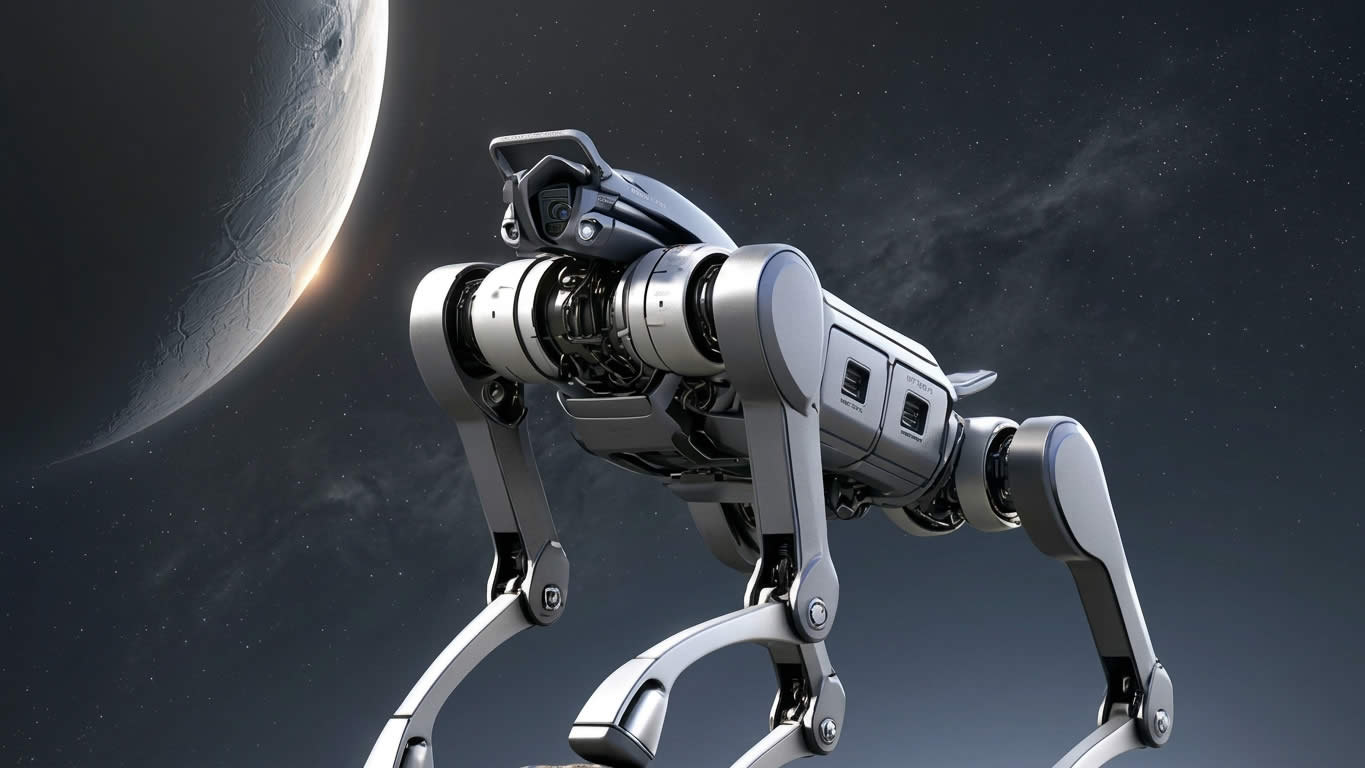
Unitree, AGIQUAD, GENISOM AI and DEEP Robotics account for more than three-quarters of global quadruped shipments. Boston Dynamics got there first. China is the one selling them.
For most of the past decade the quadruped robot was a demo. It could trot across a stage, take a kick without falling over, then go back in its crate. That phase is ending.
Counterpoint Research expects global shipments of four-legged robots to roughly double in 2026, passing 90,000 units for the first time. Vendors shipped 46,000 units in all of 2025, generating just under $700 million across the category. In the first six months of this year they moved 35,000, close to 80% of last year’s entire total. Qi Yingnan, an associate director at the research firm, puts full-year growth at about 90%.
“The technology has moved from lab demonstrations to real deployment in business scenarios,” Qi said, “and China is the force driving that shift.”
He is not exaggerating. Chinese manufacturers hold close to 90% of the global market, a concentration that echoes consumer drones, where Chinese companies control more than 70% of annual shipments.
Four Chinese Vendors, Three-Quarters of the Market
Every company at the top of the shipment table is Chinese.
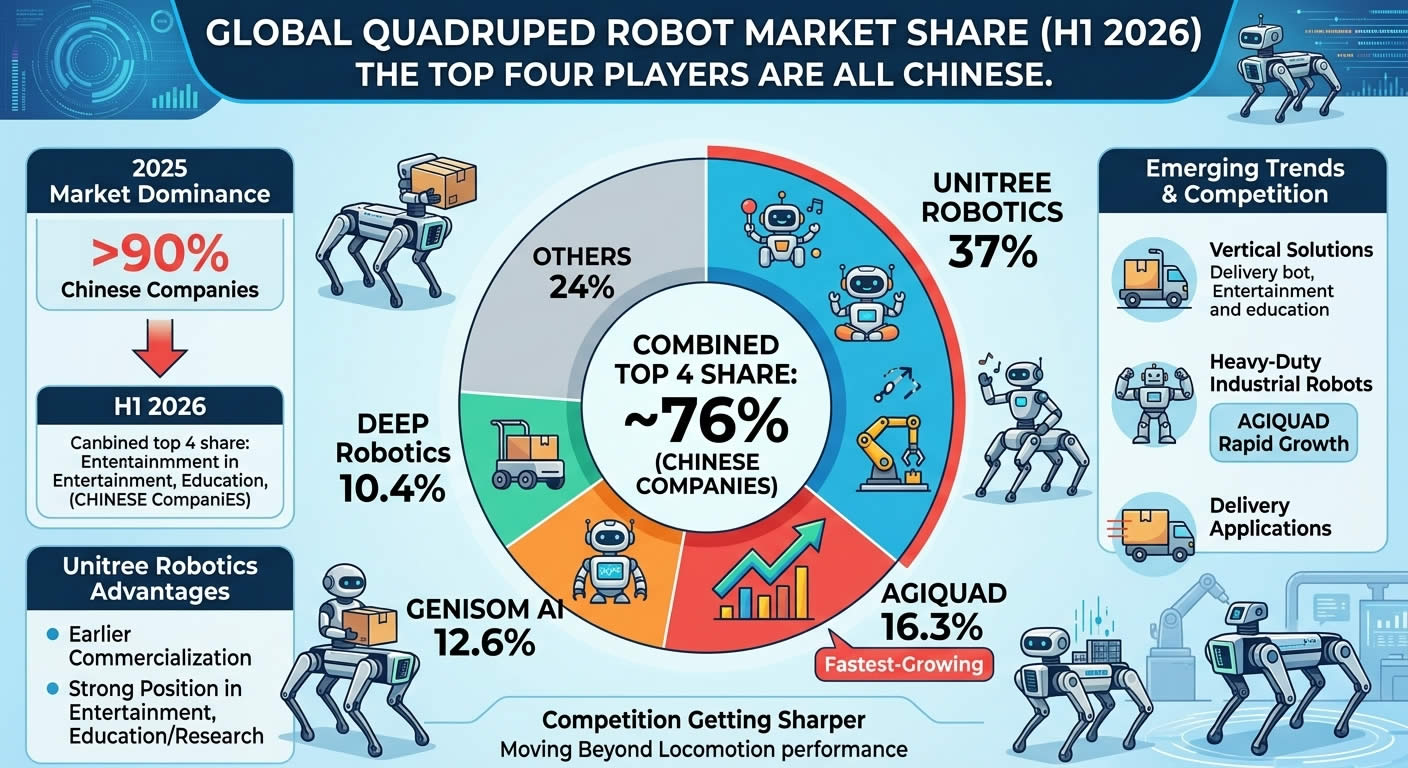
Unitree Robotics leads with 37% share. It began commercial sales earlier than almost anyone else and planted itself in two unglamorous but steady markets: entertainment and STEM education. AGIQUAD sits second at 16.3% and has been the standout riser of 2026. GENISOM AI and DEEP Robotics follow at 12.6% and 10.4%.
Together those four took 76% of global shipments in the first half of 2026. Across the whole of 2025, Chinese vendors covered more than 90% of the market.
Competition among them is already changing shape. The top players once argued over how well a machine could walk, run and catch its balance. Now the question is who can deliver a working solution for a specific industry, with hardware, sensors, software and service contracts sold together.
That contest looks different in the industrial segment, where the ranking reshuffles. AGIQUAD holds 27.8% of the industry market, ahead of DEEP Robotics at 26% and GENISOM AI at 18.9%. Unitree, dominant overall, sits fourth at 17.6% — its lead resting on entertainment and education rather than on the plant floor.
An Education Robot and a Smelter Robot Are Different Products
The two ends of the market pull in opposite directions.
In education and entertainment, buyers judge a robot on locomotion and little else. Payloads are usually under 5kg, batteries swap out in seconds, and the machine is allowed to fall over occasionally without anyone filing an incident report.
Industrial work is a harder engineering problem. A robot on a plant floor has to fuse readings from several sensors to make sense of a cluttered space and spot defects, then carry whatever tooling the job needs. Cameras, arms, gas sensors and custom rigs all push up cost and complexity.
MicBot has gone further down that road than most. The company builds for extreme heavy industry, including electrolytic aluminium and chemicals. Huang Ziyan, its chief marketing officer, points out that the electrolysis floor is saturated with magnetic interference strong enough to stop an ordinary quadruped. MicBot’s machines are built to tolerate it, and they carry a dynamic payload of up to 200kg.
That engineering shows up in the price. Unitree’s education and entertainment models now sell for the equivalent of a few tens of thousands of yuan. MicBot’s industrial units still go for around 300,000 yuan, or roughly $45,000, and hold there.
Qi expects that gap to shape the next phase of growth. Entertainment, education and a still-nascent home market all have room to expand, he says, but industrial applications will be the engine driving industry revenue up.
Boston Dynamics Got There First
The company that made the world pay attention to legged robots was American. Boston Dynamics released its Spot Classic demo in 2015 and the video went everywhere.
The business story that followed was messier. The company changed hands repeatedly, from Google to SoftBank and now Hyundai, while the machines stayed expensive and the commercial case stayed thin. Chinese vendors are the ones pushing quadrupeds into paying work at scale.
The credible Western players left in the field, Boston Dynamics and Switzerland’s ANYbotics among them, mostly chase industrial customers at high unit prices and lean on RaaS, or Robot-as-a-Service, contracts instead of outright sales.
Wu Xiang, a vice president at Pudu Robotics, does not see much daylight between the two camps on technology. The split, in his reading, comes down to timing and market choice. Western firms started earlier and built an edge in storytelling and developer ecosystems. Chinese firms sit closer to factories and physical operations, which makes them quick to iterate and good at organising supply chains. That advantage shows up in cost and in how fast orders ship.
Where the Chinese industry is still weak is the step after manufacturing: turning a capable machine into a standardised product, then into a service network that can be copied city by city.
Huang frames the bottleneck in similar terms. Mass production, he says, is not held back by motors or batteries but by the absence of standardised operating procedures for each industry, and by the lack of standardised modules that engineers can reuse across them.
The Drone Playbook, Run Again
Chinese robot makers were global from their first sale, not after a decade of scaling at home.
Unitree built a third-party development ecosystem around its hardware and picked up a large base of academic and research customers at home and abroad. AGIQUAD has moved faster on exports: overseas shipments accounted for close to 40% of its volume in the first half of 2026.
There is a precedent. In consumer drones, both the US and China produced a crowd of startups in the early years. DJI and its Chinese peers ended up with the largest share. One partner at a well-known robotics company is blunt about the parallel, arguing that Chinese firms can out-innovate their American counterparts rather than simply undercut them.
That is a confident reading of a young market. Quadrupeds are still early. Most units sold today go to schools, labs and pilot projects rather than to routine industrial work.
Wu says China’s grip on the market depends on whether core components and software keep improving, whether the industry can turn its deployments into repeatable, standardised products, and whether vendors can build local service capacity in the countries they sell into.
Qi is more specific about the risk. He expects Chinese firms to lead for several years yet, but notes that overseas manufacturers are starting to enter through third-party development of Chinese platforms. Holding a share above 90% is not guaranteed.
Counterpoint’s own forecast leaves room for everyone. It expects 2026 to be the first year global quadruped shipments pass 90,000 units, and the market to top $10 billion by 2030, growing at a compound annual rate above 60%.
