


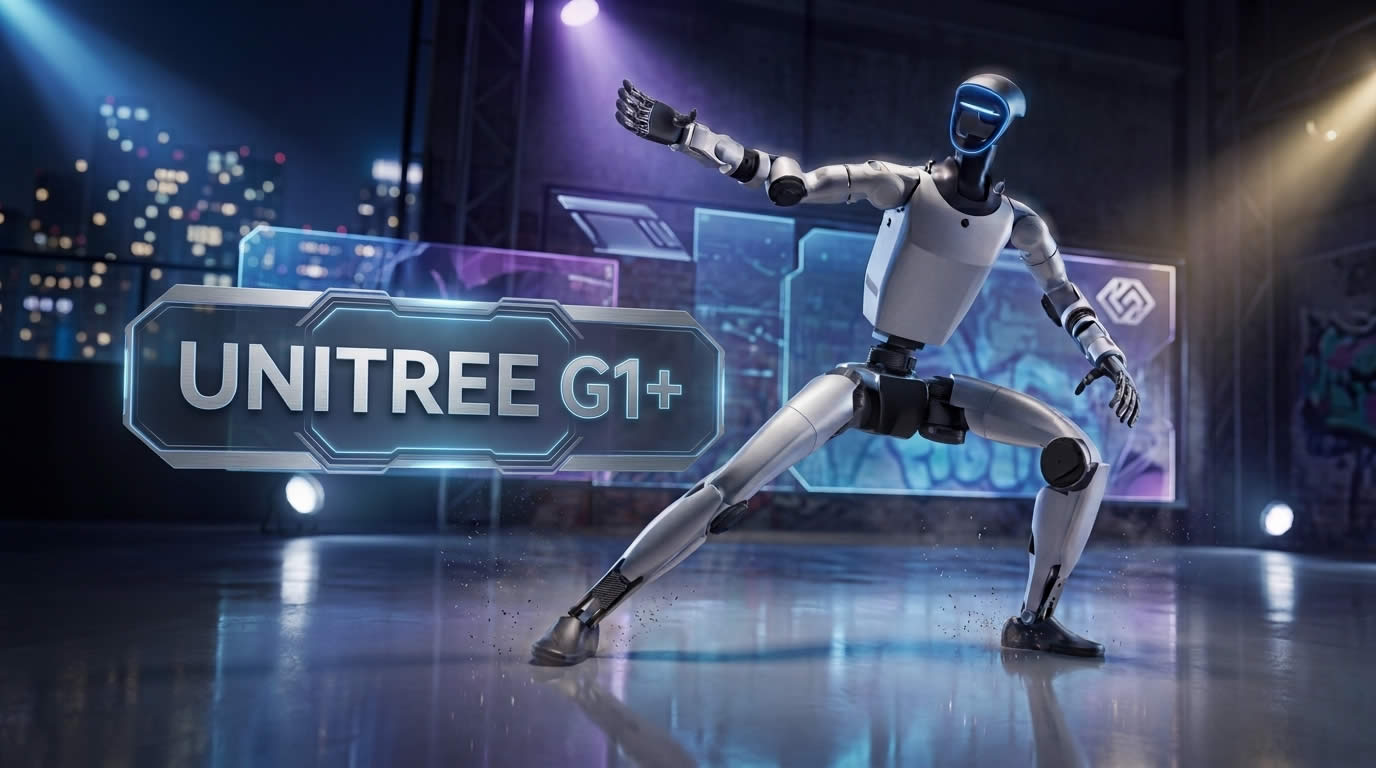
Unitree Robotics updated its G1 humanoid robot on September 14, launching the G1+ with six targeted upgrades across locomotion, perception, and interaction. In China, the standard version is priced at RMB 95,000 (about $13,300), including tax. On Unitree’s international website, the G1+ is listed at $15,000 before tax and shipping. Pricing for the G1+ EDU version, aimed at research and development, is available on request.
The headline numbers look like a spec-sheet flex: peak torque up 110% for the shoulder and waist motors, maximum arm torque up 43%, a new 2-DOF neck, and a dual-camera vision system combining stereo and wide-angle monocular cameras. But the more interesting question behind those numbers is a practical one: can the humanoid robot stay on the job longer without overheating, throttling, or needing constant intervention?
Unitree’s answer, at least on paper, is that the G1+ should hold up better during extended operation.
| Specification | G1 | G1+ |
|---|---|---|
| Standing Size | 1320 × 450 × 200 mm | 1340 × 450 × 200 mm |
| Weight (with Battery) | Approx. 35 kg | Approx. 35 kg |
| Total Degrees of Freedom | 23 | 25 |
| Single Leg Degrees of Freedom | 6 | 6 |
| Waist Degrees of Freedom | 1 | 1 |
| Single Arm Degrees of Freedom | 5 | 5 |
| Arm Maximum Load | Approx. 2 kg | Approx. 3 kg |
| Calf + Thigh Length | 0.6 m | 0.6 m |
| Arm Span | Approx. 0.45 m | Approx. 0.45 m |
| Waist Joint Range | Z ±155° | Z ±155° |
| Knee Joint Range | 0–165° | 0–165° |
| Hip Joint Range | P ±154°; R −30° to +170°; Y ±158° | P ±154°; R −30° to +170°; Y ±158° |
| Wrist Joint Range | P ±92.5°; Y ±92.5° | P ±92.5°; Y ±92.5° |
| Sensing System | Depth camera + 3D LiDAR | Binocular camera + chest wide-angle camera + 3D LiDAR |
| Microphone Array | 4 microphones | 6 microphones |
| Speaker | 5 W | 2 × 10 W |
| Battery Capacity | 9000 mAh | 9000 mAh |
| Battery Life | Approx. 2 hours | Approx. 2 hours |
What Actually Changed
The most visible upgrade is the neck. The G1+ adds 2 degrees of freedom, giving the head a pitch range of -25° to 36° and a yaw range of ±110°. That’s a small mechanical change with outsized implications for interaction. A robot that can turn its head naturally while tracking a speaker or scanning a room reads as more present, less like a security camera on legs. Unitree paired this with five touch sensors on the head — tap once to trigger a conversation or unlock a preprogrammed action. It’s a simple gesture, but it nudges the G1+ toward the kind of intuitive physical interaction that research labs and exhibition floors have been asking for.
The motor overhaul is more consequential for uptime. Unitree has also upgraded the robot’s joint motor system. It claims a 72% reduction in heat generation at equivalent torque for the shoulder and waist motors, 30% for the arm motors, and 28% for the thigh motors. For a humanoid expected to repeat demanding movements for extended periods, heat is more than a lab-spec detail. A robot that can walk for two hours but needs to cool down after twenty minutes of arm work isn’t useful for manipulation-heavy research or demonstration environments. The G1+ still uses low-inertia, high-speed inner-rotor permanent-magnet synchronous motors, now paired with local air cooling, industrial-grade crossed-roller bearings, and dual encoders. The point is less about peak numbers than about keeping performance from falling off as the robot heats up.
Perception got a meaningful bump too. The dual-camera vision system combines a stereo camera — 60 mm baseline, 2 MP, ≥500 LW/PH center resolution, and a 110° horizontal field of view — with a wide-angle monocular camera that runs at 1920 × 1080 at 30 fps and has a 117° horizontal FOV. Add the 3D LiDAR and chest wide-angle camera, and the G1+ covers a lot of spatial ground. For research teams working on SLAM, depth estimation, or embodied navigation, that sensor stack is closer to what you’d expect from a dedicated perception platform than to what you’d expect from a humanoid at this price point.
Audio is another area where the G1+ gets a practical hardware upgrade. The G1+ carries a six-microphone array (four front, two rear) with direction-of-arrival (DOA) sound-source localization, noise reduction, and echo cancellation. It supports an external wireless microphone with a claimed 50-meter transmission range and an 80 dB signal-to-noise ratio (SNR). Two 10 W speakers sit at the waist. The result is a robot that can hear and be heard in a noisy lab or exhibition hall — a small thing until you’ve tried to demonstrate a voice-interaction system next to a running HVAC unit.
Battery life remains around two hours on the 9,000 mAh quick-release smart battery, but Unitree added an external power port on the back (DC 54.6 V, 5.7 A). For research and exhibition scenarios where the robot is stationary but needs to stay online for long periods, that’s a practical way to ease the battery constraint during extended demonstrations.
The EDU Version Is Where Things Get Interesting
The standard G1+ ships with 25 degrees of freedom (DOF): 2 in the head, 6 per leg, 1 in the waist, and 5 per arm. Payload is about 3 kg per arm. That’s a capable but constrained platform.
The G1+ EDU expands to between 25 and 45 DOF, with an optional 3-DOF waist, a 7-DOF dexterous hand plus 2 wrist DOF per hand, and arm payload increased to roughly 4 kg. More importantly for research teams, the EDU version supports multiple high-performance computing modules — NVIDIA Orin among them — and is explicitly designed for custom development. The EDU also comes with an 18-month warranty, compared with eight months for the standard version.
Unitree has not disclosed pricing for the G1+ EDU; instead, it directs buyers to its sales team.
Why This Matters Beyond the Spec Sheet
The launch also comes as competition in the humanoid robot market is intensifying. According to Counterpoint Research, Unitree shipped more than 7,000 humanoid robots in the first half of 2026, giving it roughly a 31% share of global shipments. The firm estimated that AgiBot shipped about 9,700 humanoid robots during the same period, overtaking Unitree in H1 shipments. Together, the two companies accounted for roughly three-quarters of global humanoid shipments in Counterpoint’s H1 estimate. That makes the rivalry hard to ignore.
The G1+ represents a specific kind of response. Rather than chasing AgiBot’s volume lead with a lower-cost model or trying to out-spec higher-end platforms with a flagship, Unitree is doubling down on the segment where the G1 has already built a strong presence: research, education, and controlled deployment. The G1+ reads as a platform upgrade for people who already use humanoids as development tools, not as a bid for broader commercial deployment.
That’s a narrower ambition than that of some competitors, but it’s also a more realistic one. The current specifications still point more toward research, education, and development than toward a dedicated industrial deployment platform. It’s a platform a university lab can buy, develop on, and use for long-term research, with the new motor and cooling changes aimed at reducing thermal constraints during operation. The G1+ is still recognizably a G1. The difference is that more of its upgrades are aimed at keeping the robot useful after the demo is over.
