

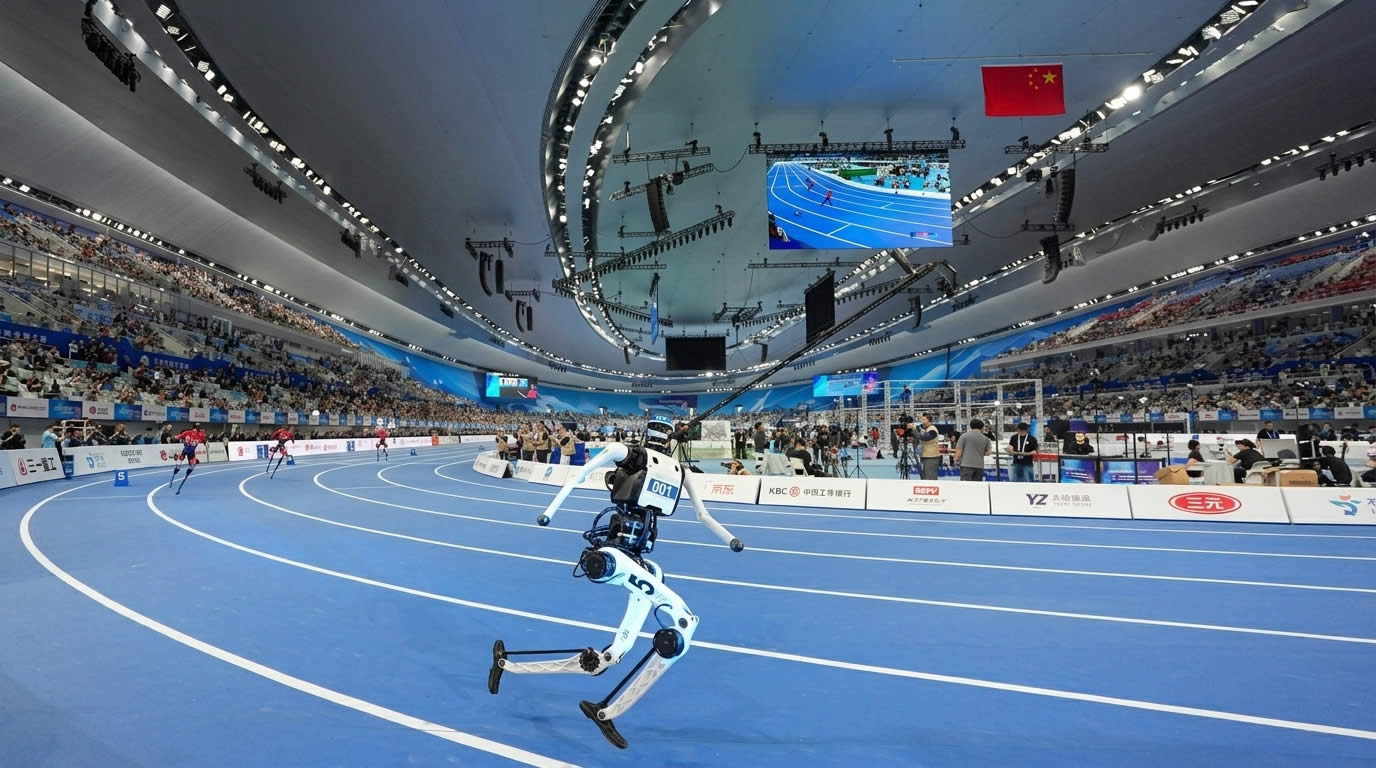
BEIJING — On the evening of August 22, a 100-meter preliminary heat at the National Speed Skating Oval, the “Ice Ribbon,” pushed the 2nd World Humanoid Robot Games into new territory.
Team Tianzhuo’s robot opened with a 9.39-second run, already faster than Usain Bolt’s 9.58-second men’s 100m world record. The mark did not last long. Tiangong-Jingfeng Technology Joint Team clocked 9.34 seconds. Honor’s Lightning had already posted a 9.32-second time in pre-event testing. By the end of the evening, multiple robots had posted times faster than the human world-record mark.
The results showed how quickly the performance bar is rising for humanoid robots.
On August 23, Tiangong Ultra, developed by the Beijing Humanoid Robot Innovation Center, won the large-robot 400m final in 38.15 seconds. That beat the 43.03-second men’s 400m world record set by South Africa’s Wayde van Niekerk in 2016. Later that evening, Tiangong Ultra returned for the 1500m, and Team Tianzhuo won in 2:21.63 — well under the 3:26.00 men’s 1500m world record set by Morocco’s Hicham El Guerrouj.
Honor’s “Lightning,” another Chinese humanoid robot, had also posted notable marks ahead of and during the Games. Honor said Lightning ran 9.32 seconds for 100m in pre-event testing, along with 40.6 seconds for 400m and 2:30.22 for 1500m. In April, it completed the Beijing Yizhuang Humanoid Robot Half Marathon in 50:26, a time well below the men’s half-marathon world record at the time.
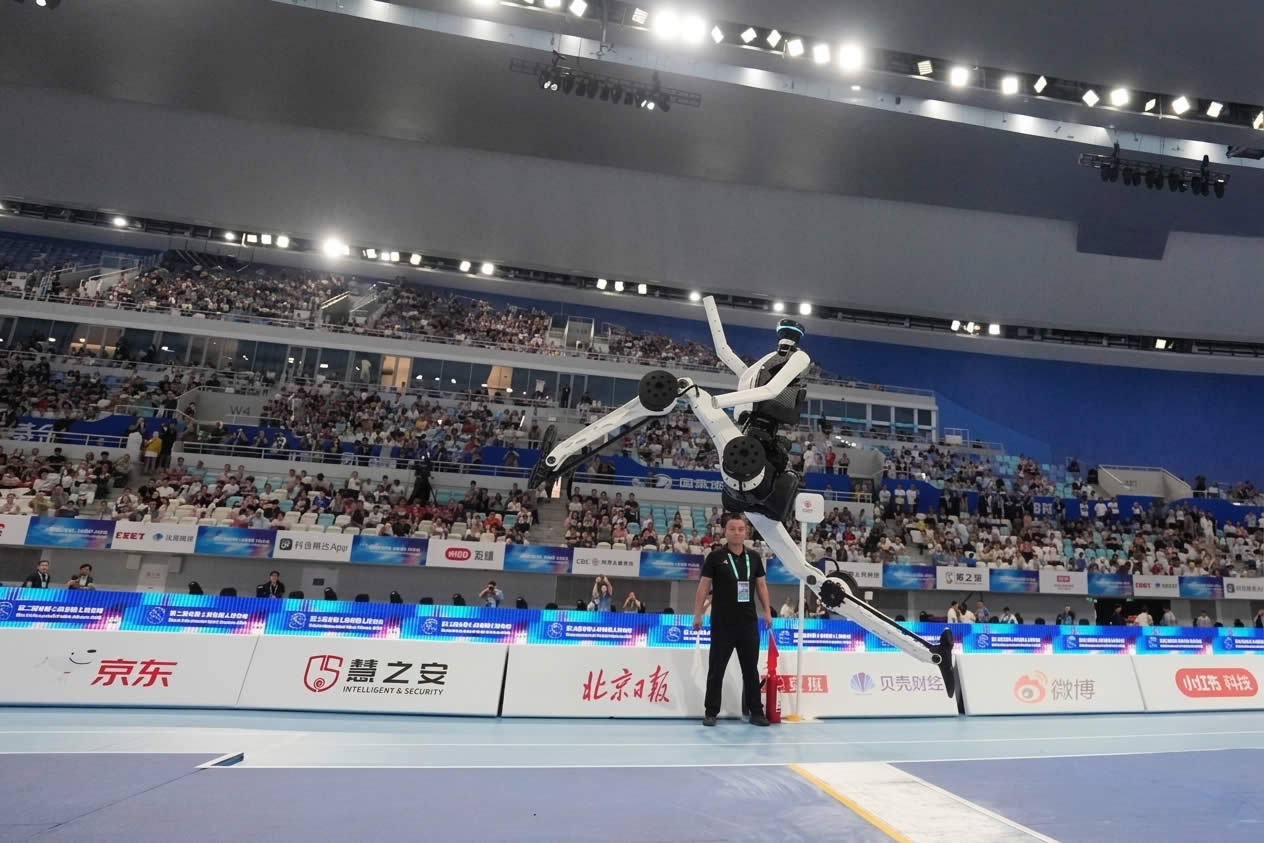
The standing high jump also produced a major result. Tiangong Ultra cleared 2.8843 meters, above the 2.45-meter men’s high jump world record held by Cuba’s Javier Sotomayor and far beyond the 95.641-centimeter winning jump at the first World Humanoid Robot Games.
A year ago, the best 100m time at the first Games was 21.50 seconds. This year, a humanoid robot posted a 9.32-second time in pre-event testing. The 400m and 1500m also produced times faster than the corresponding human world records, while the standing high jump cleared the human record by a wide margin.
A full-system test
For a human sprinter, the 100m is about explosive power, the 400m starts to test speed endurance, and the 1500m tests energy management. For a humanoid robot, those same distances pose a different engineering challenge.
A robot that runs fast has to stay stable. Joint motors must deliver enough peak torque while keeping weight, temperature rise and energy consumption under control. The faster it runs, the harder the impact on structural components, speed reducers, bearings and foot mechanisms.
Tiangong Ultra’s performance came from changes on both the hardware and control sides. The Beijing Humanoid Robot Innovation Center said it used higher-power joint motors, optimized the robot’s configuration for high-speed movement and upgraded the cooling system. The control algorithms were tuned separately for the 100m, 400m and 1500m. At high speed, the robot relied less on track lines and used autonomous navigation and path planning to stay in its lane.
Thermal management is one of the less visible problems. Running 100m is not the hard part. The question is whether the motors can sustain that output over 400m or 1500m.
China Youth Daily reported that Tiangong Omni won the small-robot 400m in 45.66 seconds. Han Gang, a motion control algorithm specialist, said Omni’s “face-covering run” was not a visual gimmick. The approach was developed through simulation training and repeated data analysis. Reducing large upper-body swings lowered shoulder load and joint heat, leaving more capability for the legs and improving energy efficiency and stability over 400m.
Motor power is only one part of the equation. Mechanical structure, control algorithms, energy management, cooling, sensors and motion strategy all have to work together.
From 21.50 to 9.32
The first Games’ 100m champion ran 21.50 seconds. One year later, the event has moved into the 9-second range.
The 9-second barrier quickly became the focus of the competition. Formal competition results included 9.39 and 9.34 seconds, while Honor’s Lightning had posted 9.32 seconds in pre-event testing. People’s Daily reported that Tiangong-Jingfeng Technology Joint Team, Team Tianxiao and Team Tiangong were among the teams that posted times in that range.
Tiangong Ultra competed in the 100m, 400m, 1500m and standing high jump. Honor’s Lightning also posted times faster than corresponding human world-record marks across several sprint and middle-distance events.
Some media reports listed only team names for the 9.34-second runs and did not identify the robot model in every case. Honor’s Lightning, however, had already recorded 9.32 seconds in pre-event testing. The results suggest that reaching the 9-second range is no longer limited to a single prototype, with multiple teams now operating at that level.
400m and 1500m: sustained output
If the 100m shows burst capability, the 400m and 1500m show whether a robot can sustain output.
In the large-robot 400m final on August 23, Tiangong Ultra won in 38.15 seconds. Team Zhuifeng Zaizai finished second in 39.45 and Team Jinghong Dynamics third in 39.66. All three went under 40 seconds. Three of the four finalists used Honor’s Lightning humanoid robot. High-speed humanoid locomotion is moving beyond one-off demonstrations and into direct competition.
The 1500m final told a similar story. Team Tianzhuo’s Tiangong Ultra won in 2:21.63. Team Feileishen took second in 2:30.00 and Team Fenghuo Shandian third in 2:30.22. All three finished far under the human men’s 1500m world record.
For a robot, the 1500m is not a 100m effort stretched 15 times longer. Longer run times force a rebalancing of battery output, drive efficiency, thermal management and control algorithms. Too much peak power creates too much heat. Cutting power too far sacrifices speed. The robot has to adjust stride, cadence and energy distribution continuously.
For embodied AI developers, the races provide a simple, visible benchmark for comparing performance.
Beyond the track
The 2nd World Humanoid Robot Games drew 666 teams and 2,056 robots from 16 countries across six continents, with 51 events. The second edition has expanded well beyond track events.
Soccer shifted from 3-on-3 to 5-on-5. With more robots on the field, visual perception, spatial localization, multi-robot coordination and real-time decisions matter more.
In the scenario events, robots must assemble power tools, pick beans with tweezers, prepare food and drinks, charge devices and handle emergency tasks. They attract less attention than a 100m sprint, but they more closely resemble the jobs robots are expected to perform in factories, warehouses, stores and eventually homes. Reuters reported that the 51 events include 30 sports and 21 scenario tasks, and more than 40 percent require fully autonomous operation.
The events are also testing a different set of capabilities. A few years ago, a robot walking, running or doing a backflip was often enough to make headlines. At this year’s Games, the emphasis is increasingly on whether it can adapt, keep working and complete a task.
The supply chain behind the records
Behind those results is a manufacturing and component supply chain that has been expanding for years.
The China 100-Person Forum on Humanoid Robots and Embodied AI released its 2026 Humanoid Robot Industry Development Report on August 20. It said China shipped more than 40,000 humanoid robots in the first half of 2026, accounting for 97 percent of global shipments. That figure measures supply and manufacturing scale, not total market share or technical capability. But it points to a manufacturing base built for fast iteration.
A humanoid robot depends on a long list of components, from motors and speed reducers to encoders, force sensors, batteries and structural parts. Many of those capabilities already exist in China’s EV, electronics, industrial robotics and drone supply chains.
China also has a large pool of real-world use cases. Factories, warehouses, commercial facilities and research labs give developers places to test robots under real-world conditions. Problems that appear in the field feed back into hardware changes, control algorithms and motion strategies.
The cycle of production, testing, feedback and iteration has helped Chinese robot makers move from demonstration units toward commercial products. Reuters recently noted that China’s humanoid robot industry is shifting from demonstrations to real-world applications in manufacturing, logistics and services. Cost, reliability and autonomy remain barriers to large-scale commercialization.
Faster does not mean smarter
A robot can post times faster than human world records in the 100m, 400m and 1500m, while a standing jump can rise well above the human high-jump record. That does not mean it has anything approaching human-level versatility.
On a structured track with clear rules, a robot can operate at high speed. In the real world, a cable that is slightly out of place, a part not where it should be, a door not fully open, or a person stepping into its path can force it to re-sense and re-plan. For a person, those are trivial. For a robot, they are not.
For all the attention around 9.32 seconds, speed alone is not the end goal. What matters is that it puts drive systems, motion control, perception and autonomous decision-making into a measurable, comparable form.
The 2.8843-meter jump also put the robot’s hardware and control system under a very different kind of test, from explosive joint output and structural strength to posture control and landing stability.
The 38.15-second 400m puts more emphasis on how the power system, cooling and control algorithms perform over a sustained effort.
The real record
Competition continues through August 26. Weightlifting, tug-of-war, dexterous hand events and more scenario tasks will follow. The more important question is not whether another robot shaves a few tenths off a record.
It is how many of the capabilities shown at the Ice Ribbon will show up in factories, logistics centers, stores and homes in the months and years ahead.
Chinese companies have now shown that humanoid robots can run the 100 meters in under 10 seconds, beat Bolt’s mark on the track, and finish the 400m and 1500m in times faster than the human world records. The next step is harder: proving they can do real work faster, more reliably and more cheaply than people.
That may turn out to be the real record set at the 2nd World Humanoid Robot Games.
