


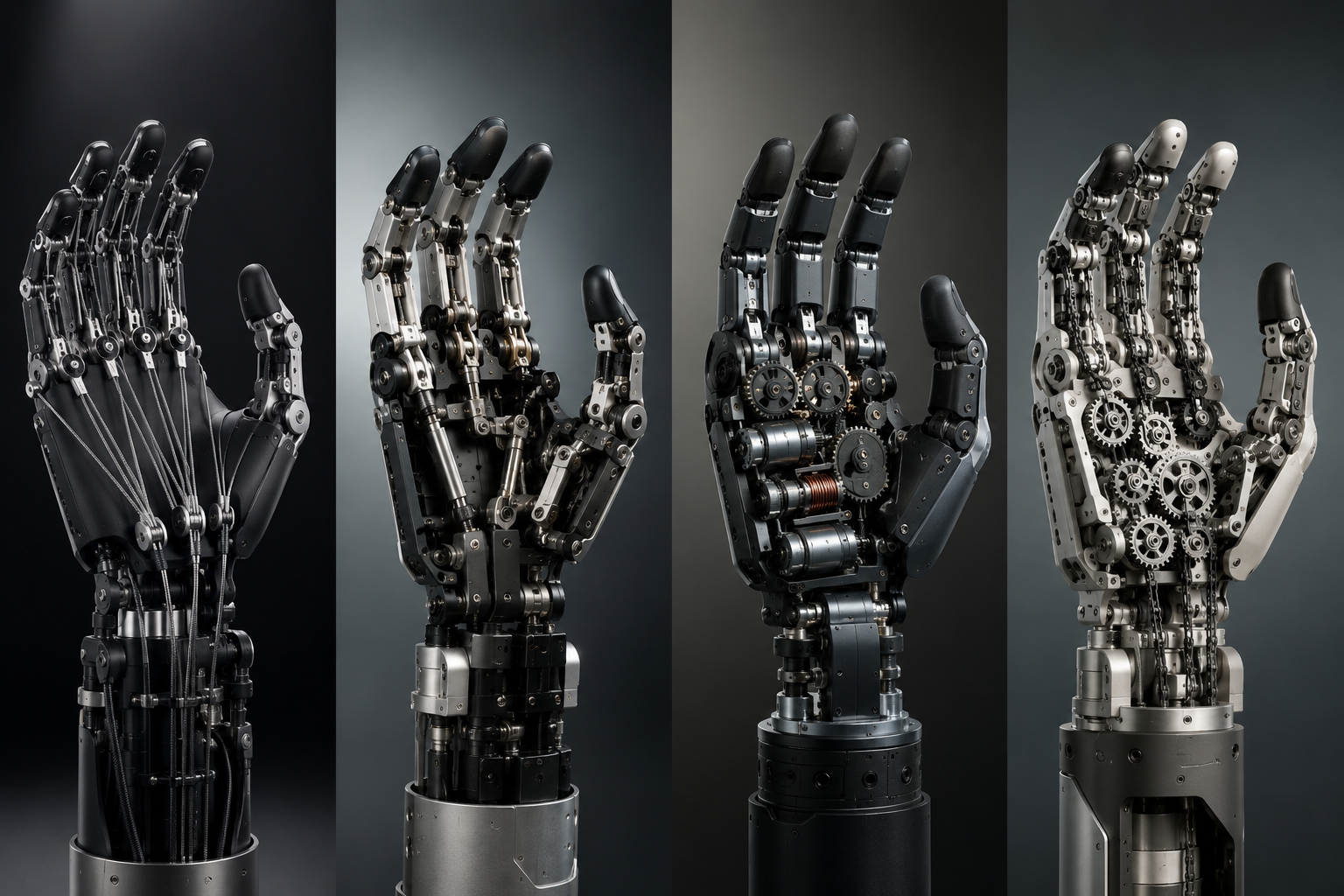
The motor is only the starting point. What really shapes the finger’s movement is the transmission system in between. That system may use a tendon, a set of gears, a linkage, a lead screw, a chain, or a compact actuator placed close to the joint.
A 2021 paper published in Nature Communications grouped the main drive mechanisms for multi-fingered dexterous hands into three categories: motor-direct-driven, tendon-driven, and linkage-driven. Today, when we look at humanoid robot hands, four drive and transmission approaches are worth understanding.
1. Tendon-Driven Robotic Hands
Tendon-driven hands work in a way that is close to the human hand. In the human body, muscles contract and pull bones through tendons. In a robotic hand, the motor pulls a tendon or cable. The tendon runs through the finger, passes around guide pulleys, and pulls the joint into motion.
One reason this design is attractive is that the motor does not have to sit inside the finger. It can be placed in the palm or even in the forearm. With fewer motors and reducers inside the finger, more space can be used for joints, pulleys, and sensors. The finger can also be made slimmer, with lower inertia.
A single finger usually needs a pair of tendons. When one tendon tightens and the other relaxes, the finger bends.
Tendons stretch. Their tension changes. Friction changes too. The motor may rotate by the same amount, but the fingertip may no longer land in the same place. The error may be small, but in a grasping task, it can be enough for the finger to miss the edge of a small object.
The Shadow Dexterous Hand is a well-known tendon-driven example. The standard Shadow Dexterous Hand has 20 active degrees of freedom and 4 underactuated movements, giving it 24 joints in total. The hand weighs 4.3 kg, uses 20 DC motors, and includes tendon load sensors.
Tendon-driven hands suit designs that need many degrees of freedom and relatively light fingers. Their weakness is maintenance. In a lab, engineers can tune the system carefully. In real use, the harder question is whether the hand can keep the same accuracy after months of work.
2. Linkage and Gear Transmission
Linkages, gears, and lead screws use a more rigid transmission path. After the motor turns, mechanical parts push, pull, or mesh with each other to move the finger joint.
Compared with tendons, rigid transmission has less elastic behavior. The finger position is more closely tied to the geometry of the mechanism. That makes it useful for tasks such as picking up parts, holding tools, or moving small objects.
A linkage design is often paired with a lead screw. The motor drives the screw, turning rotary motion into linear force. That force then moves a linkage, and the linkage rotates the finger segment. Some designs couple the middle and distal joints, so one actuator can move more than one joint. The finger then bends along a preset path.
Gear transmission works differently. The motor uses gears to reduce speed, change direction, and send power to the target joint. The movement path is stiff, and the feedback is clearer. The downside comes from the same stiffness. When the finger hits an object, the gear teeth, pivots, and linkages all have to take the impact.
DexLink Hand is a clear example of the linkage-driven route. It integrates 20 joints and is driven by 16 independent actuators. Its actuation, sensing, and transmission components are packed into a structure close to the size of a human hand. The prototype weighs 320 g. By using linkages to organize multiple joints, it reduces the number of motors while still allowing the fingers to follow human-like bending paths. It also supports multi-directional movement, joint coordination, and relatively high passive load capacity.
3. Joint-Integrated Actuation
Joint-integrated actuation places the motor and reduction mechanism as close to the joint as possible. This reduces the need for long tendons, long linkages, or distant transmission paths. The relationship between motor output and joint motion becomes more direct.
Once the motor is close to the joint, engineers can control that joint more directly. The joint can respond faster, and the force feedback path is shorter. The system can also estimate joint force from motor current, which helps with force control.
The problem is space. Motors have diameter. Reducers have diameter. Wires and sensors also need room. If the finger is expected to stay close to human proportions, there is a hard limit on how much hardware can be placed inside.
Weight is another issue. When the actuator moves closer to the finger, the finger itself becomes heavier. A heavier finger has higher inertia during fast motion. If it hits an object, the impact is more direct. During repeated grasping, opening, closing, or long force-holding tasks, heat also builds up in the palm and finger joints. The closer the hand gets to human shape, the less space it has for cooling.
Its real challenge is miniaturization. The motor, reducer, sensors, wiring, and thermal design all have to fit inside one robotic hand.
4. Chain Transmission
A chain is relatively stiff when pulled straight, but it can bend around a sprocket. That gives it some of the turning ability of a tendon and some of the stability of a rigid transmission system.
A typical motion path works like this: the motor first moves the proximal phalanx. A sprocket on that segment pulls the chain, and the chain drives the next sprocket. The motion moves from one finger segment to the next until it reaches the fingertip.
This is different from a tendon system. Tendons are lighter, but long-term stretching can lead to position drift. A chain is more stable under tension and can carry larger loads. A linkage is rigid, so impact can be sent back through the pivots. A chain can absorb some of that force.
CHOHO Hand is an example of a chain-driven dexterous hand. It has 17 degrees of freedom, including 7 active and 10 passive degrees of freedom. Its fingertip repeatability is listed at ±0.1 mm. The hand can carry more than 40 kg, has a motion cycle life of more than one million cycles, and uses micro sprockets meshing with chains for transmission.
The chain can bend around sprockets and redirect force inside a narrow finger segment. For a robotic hand, this can reduce the need for long linkages and can also reduce the position drift caused by tendon stretch.
The challenge is long-term use. Micro chains wear. They need lubrication. The clearance between the chain and sprocket affects accuracy. Sprocket size also limits the transmission ratio. If a joint needs a large reduction ratio, the space inside the finger quickly becomes tight.
What Really Separates These Four Routes?
Choosing a transmission system for a humanoid robot dexterous hand comes down to the task.
A tendon-driven hand can make the fingers lighter and support many degrees of freedom, but it brings problems in tension control, friction, and long-term calibration. Linkage and gear transmission give the hand a more defined motion path, which helps with stable gripping and repeated handling. Joint-integrated actuation shortens the transmission path and improves direct force control, but it pushes weight, heat, and packaging problems into the finger and palm. Chain transmission tries to sit between flexible and rigid transmission. It can reduce tendon-like drift while keeping some ability to absorb impact.
There is no single best answer for every robotic hand. A research hand, an industrial gripper, and a humanoid robot hand do not face the same constraints. The wrong transmission choice will not stay inside the finger. It will affect the wrist, the forearm, the control system, and the maintenance cost of the whole robot.
