


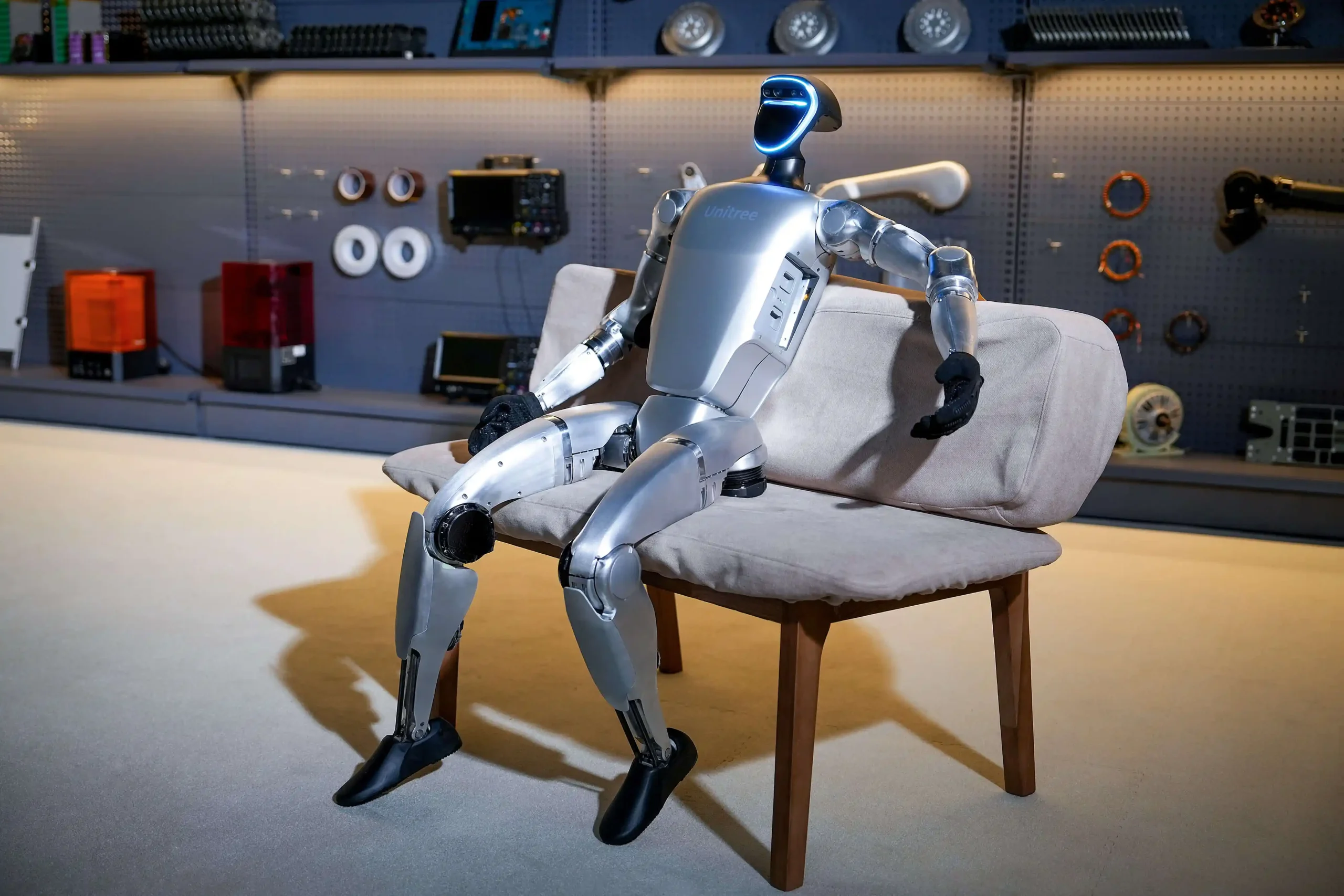
Many people first discovered Unitree through its quadruped robot dogs. By 2026, the spotlight had started to shift toward Unitree humanoid robots. On the Spring Festival stage, Unitree’s humanoid robots performed in a coordinated group routine, bringing Chinese humanoid robots into the public eye on a much larger scale.
Lately, Unitree Robotics’ IPO plans drew more attention to the company’s commercial progress.
What kinds of robots does Unitree sell? Where are Unitree robots being used? Which real-world scenarios are already testing them? These are the questions drawing more attention now.
So, where does Unitree Robotics stand in 2026?
What Robots Does Unitree Robotics Make?
Unitree’s product lineup mainly falls into two categories: quadruped robots and humanoid robots.
Quadruped robots were the company’s earlier breakout product line. Models such as Go2, B2, and A2 are used in research and education, developer projects, industrial inspection, security, and complex-terrain mobility. Compared with humanoid robots, quadruped robots have a more stable structure and a clearer application path, which have reached commercial use earlier.
Humanoid robots have become Unitree’s most closely watched direction in 2026. Products such as H1, G1, and R1 have pushed Unitree from a robot dog company into the humanoid robot market. H1 is more focused on high-performance demonstrations and research platforms. Unitree G1 has become one of the company’s most visible humanoid platforms, used in development, education, and early-stage pilot projects. R1 lowers the entry barrier for humanoid robots even further.
From its product structure, Unitree is not relying on one single robot to gain attention. Its quadruped robots support more mature applications, while its humanoid robots open up a larger growth market. Together, these two product lines form the foundation of Unitree’s global expansion story in 2026.
Unitree Robots Going Global in 2026
Haneda Airport, Japan: Testing Ground Support Operations With Unitree G1
On April 27, 2026, Japan Airlines and GMO AI & Robotics announced a trial using the Unitree G1 humanoid robot for testing ground support operations at Tokyo’s Haneda Airport.
The Unitree G1 stands 130 cm tall and weighs 35 kg. As demonstrated publicly, the robot was stationed close to the apron section where it performed pushing of cargo containers onto the conveyor system and used hand gestures to signal task status to staff. The tests involve handling of baggage and cargo; in the future, the scope may be expanded to include cabin cleaning and other ground equipment operations.
Operations in ground support involve speed and limited space with lots of repeated actions. The tests of the G1 robot at Haneda Airport demonstrate that Unitree humanoid robots start entering airport ground-handling environments.
Warsaw, Poland: Unitree G1 Enters Urban Public Space
In April 2026, a humanoid robot named Edward Warchocki went viral on social media in Warsaw, Poland. According to Euronews, the robot was a Unitree G1. A video showing it chasing wild boars in a parking lot in Warsaw was widely shared. In the footage, the robot wore a headlamp, carried a gear bag, and ran toward several boars in an attempt to move them away from an open area near a residential neighborhood.
Edward Warchocki was not directly operated by Unitree. Public reports said the robot was purchased and modified by a local Polish team. The hardware came from China’s Unitree Robotics, while its appearance, online persona, and interactive content were built by the local team. The Financial Times reported that the robot was originally a Unitree dancing robot purchased for about $25,000, then adapted by a Polish entrepreneur into an urban robot designed to interact with the public.
For Unitree, this shows what can happen after humanoid robots are exported. Overseas teams may take the same hardware platform and build very different localized applications around it, depending on local needs and public-facing scenarios.
NVIDIA Collaboration: H2 Plus Becomes an Open Humanoid Robot Reference Platform
On May 31, 2026, NVIDIA introduced the NVIDIA Isaac GR00T Reference Humanoid Robot during Computex in Taipei. It is an open humanoid robot reference design built for academic research. The platform has three main parts: Unitree provides the H2 Plus humanoid robot body, Singapore-based Sharpa provides five-finger dexterous hands, and NVIDIA provides the Jetson Thor computing platform and Isaac GR00T software stack.
H2 Plus serves as the robot body in this system. According to NVIDIA’s official information, it is nearly 6 feet tall, weighs about 150 pounds, and has 31 degrees of freedom in the body. With Sharpa’s two hands added, the full system reaches 75 degrees of freedom. This design is better suited for whole-body motion, bimanual manipulation, data collection, and embodied AI model testing.
Unitree H2 Plus has entered NVIDIA’s robotics development ecosystem. It is no longer just a standalone unitree robot for sale, but the physical body inside an open reference platform. Labs can build on this foundation to train models, develop movements, and test tasks.
How Far Has Unitree’s Global Expansion Gone?
At Haneda Airport, G1 is being tested for ground-handling support. In Warsaw, a local team turned G1 into an interactive robot for urban public spaces. NVIDIA has placed H2 Plus inside its open humanoid robot reference platform. One case is about field operations, one is about local adaptation, and one is about the research ecosystem.
These cases show that Unitree has taken its first real step overseas. The next question is whether these robots can stay there. Airports, labs, and city spaces all have their own rules. For humanoid robots to fit in, one demo is not enough. They need to prove they can work reliably over time.
