


Recent humanoid robot demos have been hard to miss. From Figure 03’s long-duration livestream of package sorting, to earlier demonstrations where two Figure robots worked together to tidy a room and fold laundry, to Atlas performing high-difficulty gymnastics movements.
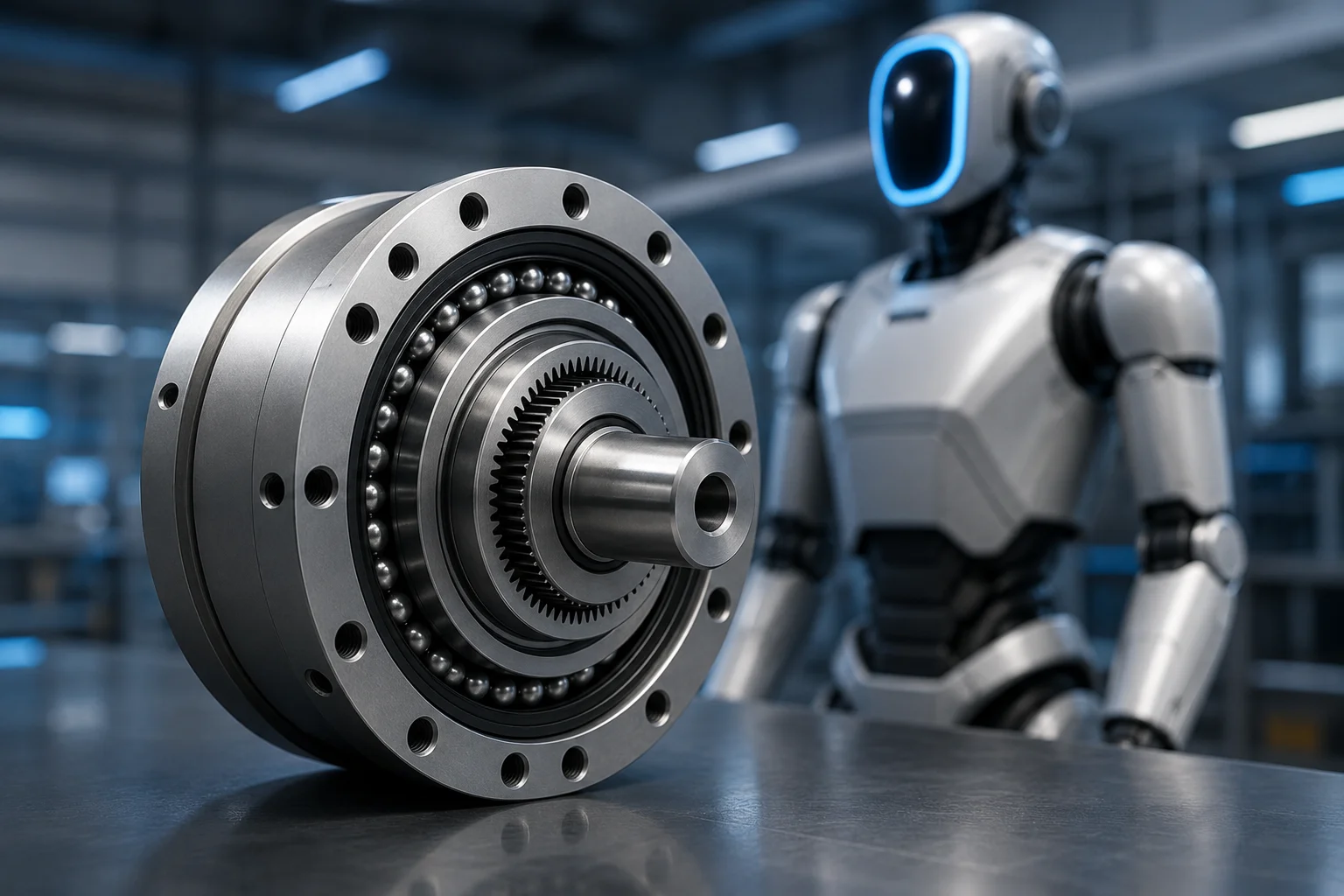
Behind these fluid movements sits a critical component: the robot reducer. Often described as the “heart” of a robot joint, it accounts for about 15% of the total cost in mainstream humanoid robots. As humanoid robots enter the early stage of mass production, this component is heading toward a trillion-scale market opportunity.
What Is a Reducer?
In simple terms, a robot reducer converts the motor’s “high speed, low torque” output into the “low speed, high torque” required by robot joints. Motors spin fast but generate limited force, similar to a system that produces output without much usable strength. With a reducer, speed is lowered while torque is amplified, allowing robot joints to generate the force needed for precise and stable motion.
The performance of a robot reducer directly determines a humanoid robot’s accuracy, rigidity, and lifespan. If the motor is the “muscle” of a robot joint, then the reducer acts like the “tendon” connecting the muscle to the bone. Without it, even strong power cannot be transmitted in a controlled way.
A humanoid robot typically requires 14 to 44 reducers, distributed across the shoulders, elbows, wrists, hips, and knees, enabling walking, grasping, jumping, and other complex movements.
Three Main Types of Robot Reducers
Different parts of a humanoid robot require different performance characteristics. Current mainstream solutions fall into three categories:
Harmonic Reducer: The “Precision Artisan” of the Upper Body
Harmonic reducers are compact, lightweight, and highly precise. They are commonly used in the shoulders, elbows, wrists, and dexterous hands where fine motion control is required. They work through elastic deformation of a flexible gear structure, achieving high-precision transmission with virtually zero backlash.
However, because the flexible component is constantly deforming, its impact resistance and lifespan are inherently limited.
RV Reducer: The “Powerhouse” of the Lower Body
Hip and knee joints must support the entire body weight, requiring reducers with high torque and strong rigidity. RV reducers excel in load capacity and structural stability, making them essential for standing and walking.
The trade-off is larger size and higher cost.
Planetary Reducer: The Cost-Efficient Option
Planetary reducers feature a compact structure, high transmission efficiency, and relatively low cost. They are widely used in medium- to low-load joints, especially in service robots or applications with lower precision requirements.
The limitation is higher backlash and lower precision.
In practice, most leading humanoid robot manufacturers in China adopt a hybrid “harmonic + planetary” configuration. Harmonic reducers are used in the upper body for precision, while planetary reducers are applied in cost-sensitive or lower-load areas.
During walking or running, the impact force generated when the foot hits the ground also places significantly higher demands on impact resistance compared to traditional industrial applications.
The Rapid Rise of China’s Reducer Industry
For a long time, the global robot reducer market was dominated by Japanese companies. Harmonic reducers were largely controlled by Harmonic Drive Systems, with a global market share exceeding 80%. RV reducers were led by Nabtesco. At one point, the lifespan of domestic robot reducers was around 7,000 hours, compared to 10,000 hours for Japanese products, showing a clear gap.
That situation is now changing. Chinese manufacturers are rapidly catching up technologically while gaining a strong cost advantage. At equivalent performance levels, domestic robot reducers are typically 20%–30% cheaper than imported ones.
Leader Harmonious Drive Systems (Green Harmonic) is a leading domestic harmonic reducer manufacturer, with over 60% market share in China and ranking second globally. Its proprietary “third harmonic” technology extends product lifespan to around 10,000 hours, close to international standards, while reducing costs by about 40%. Orders are already scheduled through 2027, with a 2026 shipment target of 800,000 units, serving clients such as Tesla, UBTECH, and Xiaomi.
ZhenKang Transmission (Double Ring Transmission) is a benchmark in RV reducers. Its products are used in high-load joints such as hips and shoulders. Costs are more than 30% lower than overseas alternatives. Its subsidiary, Hangzhou Ring Technology, increased market share from 10.11% in 2021 to 24.98% in 2024 and has been validated by customers including Tesla.
Zhitong Technology has made breakthroughs in RV reducers, with products now widely used by leading industrial robot companies in China, achieving near 100% market coverage. It has also developed the CT-HYP series quasi-double gear transmission joint module, a domestic innovation.
Other players such as Fengguang Precision, Wanliyang, and Guomao Holdings are also entering the field from different angles, forming a broader domestic robot reducer ecosystem.
According to industry forecasts, the global humanoid robot reducer market is expected to grow from 2.47 billion RMB in 2025 to 166.03 billion RMB by 2032, with a compound annual growth rate of 82.9%.
Driven by mass production and domestic substitution, robot reducers are becoming one of the most promising segments in the humanoid robotics supply chain. The future of humanoid robots is accelerating, starting with these precision transmission systems.
