

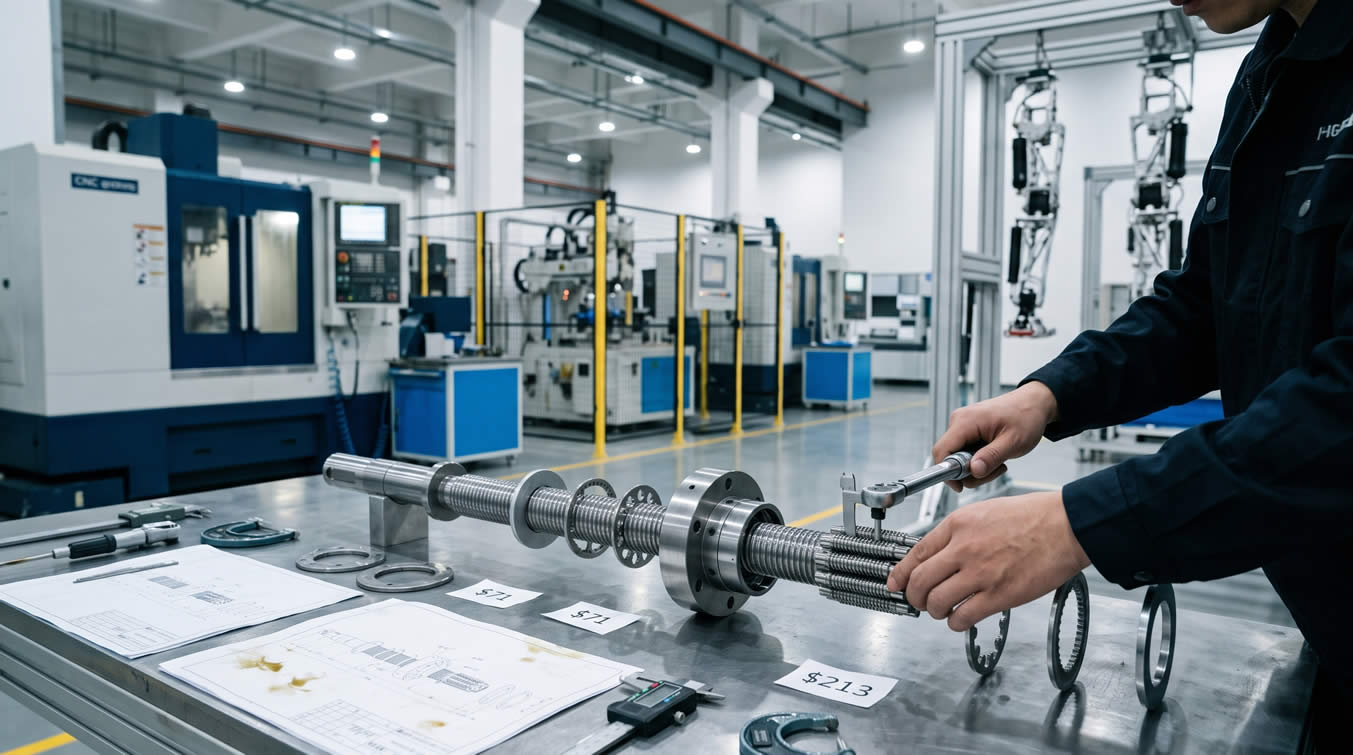
The knee of a walking humanoid carries the whole machine’s weight and turns it into a torque at the joint. Something has to answer that torque, and the answer is a steel rod about the width of a thumb. When the geometry of that rod drifts by a few microns, the robot does not fall over. It walks slightly wrong — a hitch in the gait, a foot landing where the controller did not plan it, a correction issued a hundred times a minute that never quite wins. Engineers spend weeks hunting that in the software. It is usually not in the software.
Three microns is about a ten-thousandth of an inch, which is what a machinist means by “a tenth.” It is the precision scale high-grade screw manufacturing works at, and it is why the part belongs in the argument about what actually limits a humanoid rather than in the bill of materials. Force density, positioning accuracy and unit cost all converge in this one component. So does the thing software cannot do anything about: a control policy can be retrained overnight; a grinding wheel cannot.
For four years that argument was made by mechanical engineers to people who wanted to talk about foundation models. Then a Chinese supplier published a price list, and the part stopped being a specialty item.
In January, Shuanglin Group, a Ningbo automotive-components maker, announced mass production of a C3-grade planetary roller screw at 499 yuan — about $71 — and priced the linear joint module around it at 1,499 yuan, or roughly $213. The distinction matters: the screw is the hard part, the module is what a robot bolts on. China Daily, which first reported the launch, put the comparable imported part above 5,000 yuan — near $700 — without specifying grade, and grade is most of the price. Shuanglin says the screw took three months to develop, on grinding equipment that already held three-micron tolerances for automotive work. The same account says more than 20 joints in XPeng’s IRON use its parts. Between a February 2024 low and an April 2025 peak the stock rose 1,366 percent, which is what a market does when it decides a car-parts supplier has become a robot company by accident.
None of that makes it the core component. It makes it cheap. The case for the stronger claim is mechanical, and it starts with what the part is doing in there.
A screw drive does one thing: it turns a spinning motor into a straight push. The motor spins, a nut travels along a threaded shaft, the shaft extends or retracts, the limb straightens. In a humanoid that conversion is the bridge between two things that do not resemble each other — a brushless motor, which makes its torque at speed and hates being stalled, and a leg, which needs a few hundred pounds of force applied along its length at a speed a human would recognize.
A ball screw runs steel balls between the nut and the shaft. Contact happens at points. Friction stays low, efficiency lands near 90 percent, and the manufacturing process has been mature for most of a century, which is why a ball screw is a commodity you order out of a catalog. A planetary roller screw runs threaded rollers around the shaft instead, so contact happens along lines rather than points. The load spreads across far more surface area. Manufacturers claim several times the capacity and the life at the same diameter.
You pay for that in everything else. The rollers have to be ground to tolerances that make ball screws look forgiving. The thread geometry has to stay synchronized across every roller in the nut, or the load arrives unevenly and one roller dies first. Heat treatment moves the part after you have already ground it, so the sequence of grind, harden and finish-grind becomes a recipe that takes years to stabilize. Efficiency can also be lower than a ball screw’s, depending on the design: the geometry is more complex, and the rollers slide as well as roll. The load capacity is bought in manufacturing complexity and in heat.
Tesla picked the harder one. Analysis of Optimus actuators published by IEEE Spectrum describes an integrated inverted roller screw in the linear joints — inverted because the nut spins and the screw travels, which lets the motor wrap around the nut and keeps the assembly short enough to hide inside a leg.
Why a screw at all, when a rotary actuator with a strain-wave gear is smaller and better understood? Because the knee and ankle are not the shoulder. They carry the whole machine and they take the landing: a 130-pound humanoid stepping off a curb puts a multiple of its body weight through one leg in milliseconds, and the joint has to answer that at a lever arm measured in inches.
Then there is the consequence that never makes it into a spec sheet. Some low-lead designs resist back-driving, but whether a joint holds position when the power drops depends on the screw geometry and the actuator around it. That matters: a hand that should yield when it meets a person, or a foot that should absorb a stumble, still has to respond — and without the right mechanical design, that work lands on the controller, the motor drive and the sensors. Every humanoid program is having this argument right now, joint by joint, and none of them is having it in a keynote.
Grinding a seat adjuster screw to three microns is not glamorous work. It is a wheel, a dressing schedule, a coolant flow and a heat-treat oven whose distortion you have characterized over years of scrapping parts. It is also almost exactly the skill set a roller screw demands, which is the part of the Chinese supply chain that gets misread from a distance. Labor is a rounding error in a ground component, so the usual explanation for Chinese cost advantage does not apply. What matters is that the country has thousands of shops that have spent decades grinding hardened steel to single-digit-micron tolerances for carmakers, so a robot joint arrives as a new drawing rather than a new capability.
Wuzhou Xinchun is the other half of that argument. In July the company said it had won an order from XPeng for 14 integral planetary roller screws for IRON — the load-bearing joints in the legs and waist, not the hand. In August the main structure of its new plant was completed; trial production is targeted for the end of 2026, against a planned capacity of 2.1 million screw sets a year.
The other end of the same problem
Nousbot, a Shenzhen company founded by an engineer trained at Tongji who came out of Valeo, makes a planetary roller screw 1.5 millimeters across — about a sixteenth of an inch — with a 5.5-millimeter nut, and calls it the smallest in mass production. That claim is unverified. The published maximum load for the screw is about 11 pounds; a separate micro linear actuator built around it is rated at roughly 33 pounds of thrust, and the two get confused routinely. What a screw can carry is not what an actuator can push. The company also quotes repeatability of plus or minus 0.01 millimeter and a life of three million cycles. Whether that survives independent testing is unknown. The money has moved anyway: a round above 100 million yuan in March led by a Shanghai semiconductor fund, and a second near that size in August led by Shunwei Capital, both to expand this capacity.
Fingers are where the screw becomes unavoidable again, because a finger has no room for a rotary actuator, a gearbox and a pulley. A hand with 20-plus degrees of freedom packs its drives into a space where each one is about the width of a pencil, and that is a different order of manufacturing problem than a knee. It is also where the screw’s weaknesses hurt least: short stroke, low load and a designer happy to trade efficiency for packaging.
Two million screws, twenty-five thousand robots
Global humanoid shipments in the first half of 2026 came to roughly 25,000 units, up 432 percent year over year, with AgiBot alone accounting for more than 8,600. Morgan Stanley raised its full-year China forecast from 28,000 to 50,000 in June. That is real growth for an industry that shipped close to nothing in 2023, and it is nowhere near enough to fill what is being built.
Wuzhou Xinchun’s new humanoid and automotive components project is designed for 2.1 million planetary roller screw sets a year, alongside robot bearings and automotive parts. The whole project, not the screw line alone, is built for about 3 billion yuan in annual output value at full capacity — roughly $425 million. Its robot-components revenue in the first half of 2026 was around 20 million yuan. Those are not the same kind of number — one is a full-capacity annual target, the other six months of actual sales — which is the point.
The unit conversion is where the industry’s own arithmetic gets slippery. At the 14 screws per robot that Optimus-class designs use, 2.1 million sets would serve about 150,000 humanoids a year. Morgan Stanley expects China to ship 50,000 in 2026. Three times a forecast is a bet a parts supplier can defend, and it only pays if the line qualifies, ramps and holds tolerance. It also assumes the 2.1 million figure means roller screws. Some of the company’s own project documents describe 980,000 roller screw sets alongside 2.1 million micro ball screws for hands, which would put the robot-equivalent number nearer 70,000.
Wanxiang Qianchao, a driveline supplier that adapted existing automotive lines, cites 100,000 roller screw sets. That is a fraction of Wuzhou’s target, though the two should not be read as like-for-like until product grades and unit definitions are confirmed. Both are betting on the same curve and reporting it at very different scales.
Both can be wrong in the same direction, and the accounting does not care who was right. A line that is finished but not loaded shows up as depreciation before it shows up as revenue, and Chinese listed companies report every quarter. If shipments land at 100,000 in 2027 instead of a million, the cost of that idle line lands in the margins, quarter after quarter, in public.
The counter-argument is defensible. A screw line can take years to stand up, so a supplier that waits for firm orders has already lost them. Capacity built ahead of demand is what a supply chain looks like when it believes a curve. Capacity built three times ahead of a forecast, with the plant not yet in trial production, is what a supply chain looks like when the alternative is being left out of the next design win.
What would break this
The largest risk here is architectural. If the joints change, the screw stops being the core component of anything.
Planetary roller screws are not a physical necessity. They answer one specific design choice: put the motor in line with the limb and convert rotation into thrust. Knee and ankle joints can also be built with quasi-direct-drive motors, which have improved sharply as magnet and winding technology matured, or with strain-wave gears and a linkage. Every one of those routes deletes the screw from the bill of materials.
Unitree has pushed high-torque-density joint motors hard across its lineup. Boston Dynamics’ current Atlas is electric and does not advertise a screw-driven architecture. If a large share of the industry converges on direct drive for the legs, a 2.1-million-unit roller screw line stops being a strategic asset and becomes a fixed cost bolted to a floor. That is the asymmetry worth noticing: the robot company can hedge by designing two joint types. The parts company cannot hedge at all, because its bet is poured concrete and a grinding cell.
A second risk is closer to the ground. Being in the supply chain and shipping volume are different states. Wuzhou’s 2026 interim report says several robot components are in customer validation and small-batch delivery. It does not break out volumes by customer. That is real progress, and it is not a purchase order for 200,000 units. Yield ramps along a curve nobody publishes, and that curve is where most precision-parts programs die.
A third risk is the price itself. A 499-yuan screw is a market-entry weapon right up until competitors can match both the cost and the quality. Zhejiang and Jiangsu already have most of the grinding equipment and the automotive-precision habits a screw line needs; what they do not have is a proven yield curve at C3 grade. The moat, if there is one, is the dressing schedule, and dressing schedules leave with the people who keep them.
Someone will design a leg without a screw in it, and the leg will work. It will not get ten times cheaper in ten months, because that is not a software property. It is what a grinding supply chain does when it decides a market is real — and it is why the screw drive is the core component this year even for people who are sure it will not be one later.
The number that decides whether any of that holds is not in a press release. It is the count of times an operator dresses a grinding wheel in a shift before the tolerance drifts and the batch goes to scrap. That number sets the true capacity of every line in this story, and no company publishes it, because the honest version is unflattering. Two million screws a year is a bet on how often a wheel can be dressed and still hold three microns, repeated across thousands of parts, month after month, without the scrap rate climbing.
Somebody is going to find out whether the claim is true. The robots will not tell you. The quarterly report will.
