


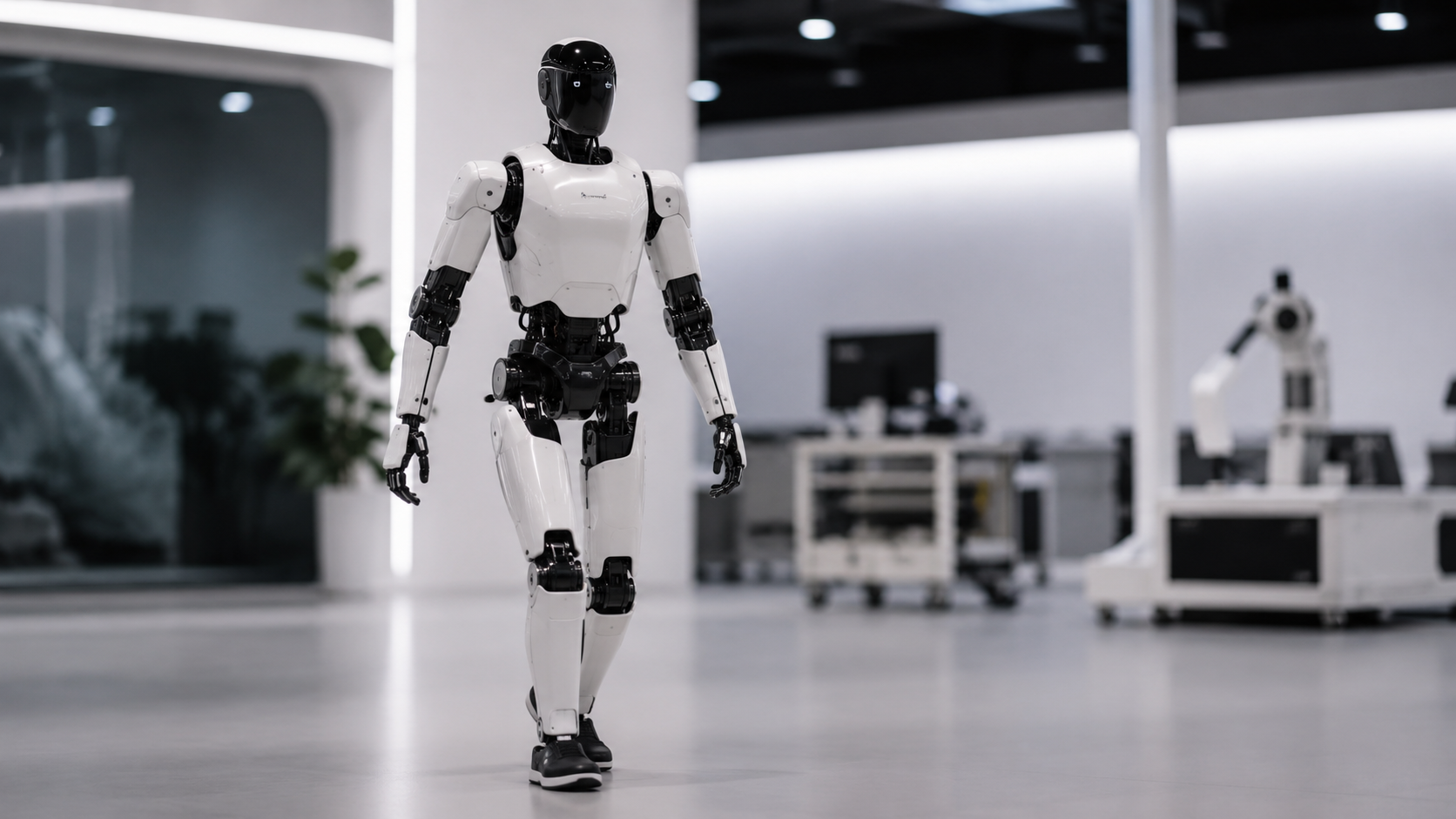
When people hear the words humanoid robot, they often picture Rosie from The Jetsons. Today, that idea is no longer just a fantasy. Humanoid robots are beginning to appear in labs, factories, exhibitions, and even early home-service demos.
A humanoid robot is a general-purpose robot designed to resemble the human body, often with two legs, arms, hands, and a torso. The goal is to build a machine that can work alongside people and help improve productivity.
The development of AI is also changing what humanoid robots can do. AI helps the robot understand speech, recognize objects, plan actions, and respond to changing environments. The humanoid body then turns those decisions into movement: walking across a room, picking up a tool, opening a door, or handing an object to a person. In that sense, a humanoid robot can be seen as a physical body for AI.
What Are Humanoid Robots Used For?
Right now, the main uses of humanoid robots are still concentrated in places where the environment is more controlled and the tasks are easier to define.
1. Manufacturing
In factories, humanoid robots are used for repetitive jobs such as moving parts, checking surfaces, handling boxes, tightening screws, or helping with repetitive station work.
A good example is UBTECH’s Walker S series. In automotive manufacturing, Walker S has been tested for tasks such as visual quality inspection, parcel handling, SPS sorting, screw tightening, part assembly, and process material handling. UBTECH says Walker S can conduct visual inspections on automotive production lines with an accuracy rate above 99%, and Walker S Lite has been introduced into FAW-Volkswagen Qingdao’s intelligent manufacturing demonstration factory for quality inspection training.
2. Warehousing and Logistics
Warehouse operations involve a large number of physical tasks, such as carrying boxes, moving bins, unloading materials, stacking containers, and recycling empty turnover boxes. Humanoid robots in logistics can reliably handle long hours of material transport without frequent human intervention.
AgiBot’s A2-W robot has already been put into regular industrial operation in a production-line feeding scenario at Fulin Precision, completing the delivery of 1,000 turnover boxes in a single shift. A larger-scale deployment is planned, involving nearly 100 robots across multiple Fulin Precision factories. The application scope will expand from the initial two production points to 15 feeding points in the powertrain and reducer workshops.
3. Commercial Service
Some humanoid robots are being used in banks, hotels, exhibition halls, shopping centers, and public service areas. Their roles are relatively clear: greeting visitors, answering common questions, providing directions, and offering a more interactive service experience.
Fourier’s GRx series fits into this category. Its GR-1 and GR-2 humanoid robots have been used in guidance and consultation scenarios. China Construction Bank’s Shanghai Pudong Branch has set up a humanoid robot “bank lobby manager” training base. Built with support from Fourier, the project is designed to train humanoid robots for real bank work, such as greeting customers, answering basic service questions, helping with queue numbers, and practicing human-robot interaction in a financial services environment.
4. Research and Education
Universities, labs, and AI teams need physical robots to test movement, manipulation, imitation learning, reinforcement learning, and vision-language-action models.
In 2025, China’s first national humanoid robot teacher-training program used the G1 EDU platform to train university and research institute instructors. The program covered robot system architecture, simulation, walking control, perception, object recognition, localization, path planning, SDK-based motion design, and even voice-control deployment with large language models.
5. Home and Healthcare
The home is one of the most challenging environments for humanoid robots. For the general public, they need a robot that can fold laundry, cook meals, bring medicine, watch over elderly parents, or clean up the living room.
SeeLight S1, a home-service humanoid robot developed by China’s GigaAI, has been shown in a demo doing household tasks such as chopping vegetables, frying eggs, loading a washing machine, hanging laundry, making a bed, and opening curtains.
Humanoid robots are being used first where the environment is controlled and the task is clear. Factories, warehouses, service spaces, and research labs are moving faster. Homes may come later, once robots become safer, cheaper, and much more reliable.
What Challenges Do Humanoid Robots Still Face?
From playing ping-pong to dancing and even running marathons, today’s humanoid robots can already handle a surprisingly wide range of complex movements. But for humanoid robots to become truly useful, they still need to cross several barriers in technology, supply chain, cost, safety, and real-world reliability.
The hard part is that all of their systems have to work together at the same time. A robot needs clear vision, balance, dexterous hand control, task understanding, and the ability to make safe decisions in real time. If the floor is uneven, the lighting changes, or a worker suddenly steps into its path, the robot cannot simply freeze or wait for human help. It has to adapt.
Cost is another major barrier. A humanoid robot brings together many expensive components, including actuators, motors, reducers, sensors, cameras, batteries, chips, and dexterous hands. These parts need to be strong, precise, lightweight, and reliable all at once. That is a difficult balance, and it is one reason humanoid robots remain expensive to build and deploy.
Safety is just as important. There are two major concerns. The first is physical safety. When a humanoid robot moves, it carries real weight and momentum. If it loses control, it could hurt people nearby, especially older adults with limited mobility or children who cannot protect themselves.
The second concern is privacy and cybersecurity. Home robots may be equipped with cameras, microphones, and other sensors that collect data around the clock. If that data is leaked, or if the robot is remotely controlled by hackers, the consequences could be serious.
Will Humanoid Robots Replace Humans?
Since the word “robot” first entered public use, one question has never really gone away: will robots replace humans?
In the long run, humanoid robots may become more than cold machines. They could become assistants, caregivers, companions, or tools that extend what humans can do. But we should not frame the relationship between humans and robots as a conflict. A better future is one where humans and robots coexist: people make decisions, robots take on part of the physical burden, and both work together in the same world.
