


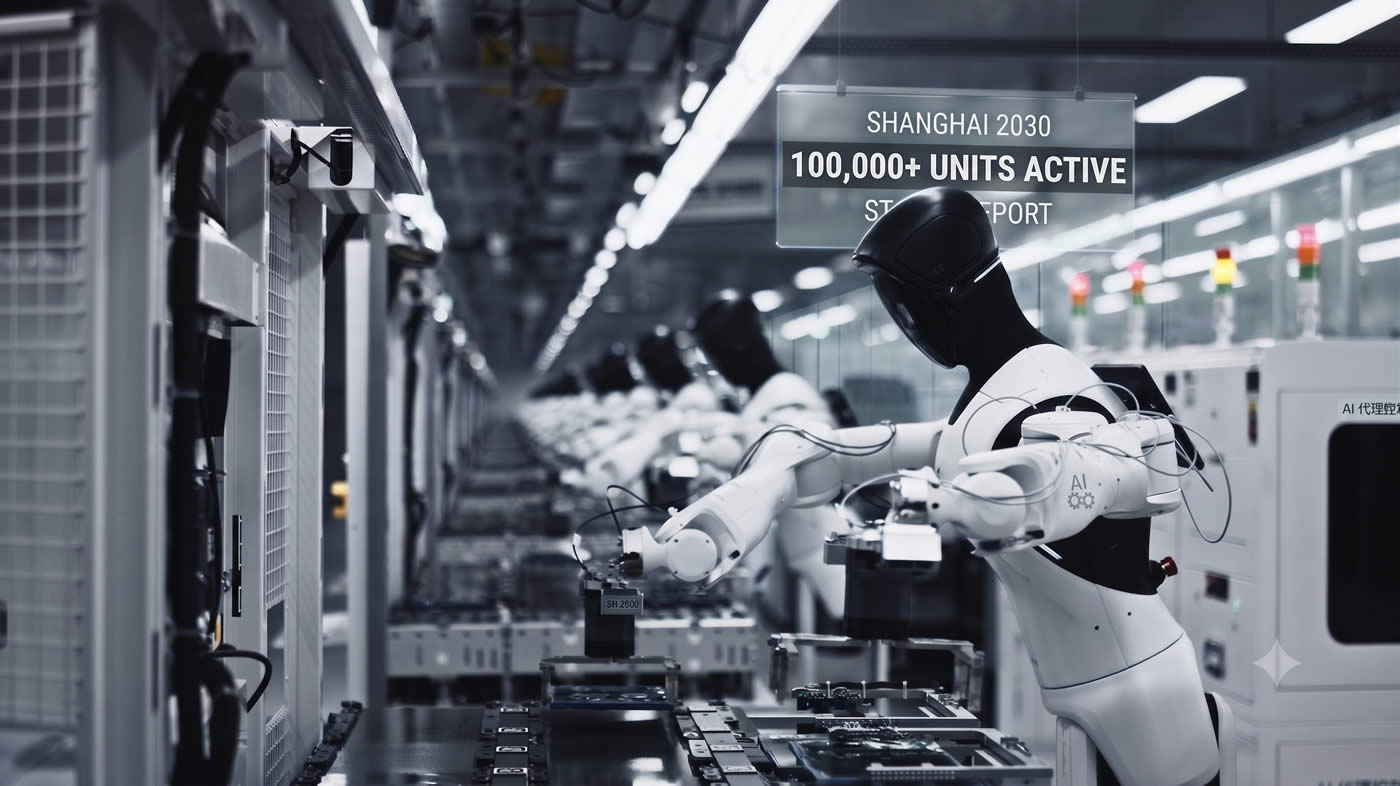
— Shanghai has set a deadline. By the end of 2030, the city expects 100,000 humanoid robots to be working inside its factories. At the same time, it wants over 80% of its large industrial enterprises to be running AI agents on a daily basis.
This is not a vague technology pledge. It is a number, a timeline, and a specific landing zone — the factory floor. Shanghai is trying to define what the scaled adoption of humanoid robots looks like, and it is doing so from both the supply side and the demand side at once.
A city that changes lanes
Shanghai has a habit of picking its next lane early.
In the 2000s, it was automobiles. The city turned its Jiading district into something resembling a Chinese Detroit. SAIC partnered with Volkswagen and GM, and later brought in Tesla. The auto industry became a pillar.
In the 2010s, the bet shifted to semiconductors. Zhangjiang, once farmland, became the epicenter of China’s chip industry. SMIC, Hua Hong, and Spreadtrum all grew up there.
In the 2020s, the city went after artificial intelligence. Companies like SenseTime, Yitu, and CloudWalk emerged, though the results were mixed.
Now Shanghai is betting on humanoid robots. For its 15th Five-Year Plan period (2026–2030), the city has put three hard targets on the table: 100,000 humanoid robots deployed in factories; intelligent-agent adoption exceeding 80% among industrial enterprises above a designated size; and 10 model companies building what it calls “AI-native factories.”
This is the first time a Chinese city has attached a concrete number to its humanoid robot ambitions, and it chose to place those robots squarely in advanced manufacturing.
Why Shanghai? Not because humanoid robots are a hot topic, but because the city has cards that others do not.
- A deep manufacturing base. Shanghai’s industrial backbone rests on three pillars — integrated circuits, high-end equipment, and automotive manufacturing. These happen to be the most obvious applications for humanoid robots. A car assembly line needs arms that can handle heavy, irregular parts. A chip fab needs precision that goes beyond human steadiness. High-end equipment manufacturing runs around the clock. Shanghai does not need to go looking for use cases. The use cases are already standing there, waiting for the robots to arrive.
- A dense supply chain. Inside the Zhangjiang Robot Valley, 73 companies sit within walking distance of each other. Precision bearings for dexterous hands. Embodied AI models for the “brain.” Reducers, sensors, perception systems — the neighborhood has them all. There is a saying in Pudong: “Upstairs is your supplier, downstairs is your customer.” It is not a metaphor.
- Money, and a clear willingness to spend it. The city is putting up 1 billion yuan annually in vouchers for computing power, language data, and AI models. Companies can use them on a “try first, pay later” basis, often with no application required. A municipal AI fund of 22.5 billion yuan has helped unlock a 60 billion yuan national AI fund.
The players on the ground
The policy framework is one thing. But Shanghai has also produced a cluster of companies that are already shipping hardware.
AGIBOT is the fastest out of the gate. Founded in 2023, it shipped 5,168 units in 2025, claiming 39% of the global market, according to Omdia. Its founder, Peng Zhihui — known online as “Zhihuijun” and once a “Genius Youth” hire at Huawei — made a strategic choice: AGIBOT sells not just the robot body, but also the brain. The company developed its own embodied AI foundation model, the QiYuan model, and packages it with the hardware. The business model is stickier when you sell both. The valuation has climbed to 15 billion yuan, with backers including Tencent, JD.com, BYD, and LG Electronics.
Fourier Intelligence is the veteran. Founded in 2015, it began with rehabilitation robots, spending nearly a decade accumulating real-world motion data. That data moat now feeds into its humanoid products. Fourier completed its shareholding reform in 2025, putting an IPO on the horizon. It has raised over 10 rounds of funding, including a Series E round of nearly 800 million yuan in 2025. Its GR-1 and GR-2 models have been delivered in batches of over a hundred units, deployed in bank lobbies, tourist sites, and research labs.
Keenon Robotics is the most battle-tested in commercialization. Founded in 2010, it is an unspoken champion in commercial service robots, with cumulative shipments exceeding 100,000 units across more than 600 cities in 60 countries. SoftBank Vision Fund and Alibaba are among its investors. Keenon’s path into humanoid robots follows a clear logic: it comes from service environments — restaurants, hotels, hospitals — and it intends to go back to those service environments, just with a different form factor.
Kepler Robotics is the most pragmatic. Also founded in 2023, it skipped the grand narratives and aimed directly at the factory floor. Its K2, nicknamed “Bumblebee,” has dual arms with a 30 kg payload, and can run for 8 hours on a 1-hour charge. It has already collected thousands of pre-orders and is working on SAIC-GM production lines. Kepler’s investor list is telling: all industrial capital — companies like Zhaofeng, Hanwei, and Ke Li Sensing. Deep ties to industrial backers anchor the company to real demand.
Three problems that still need solving
A target is set. Now comes the hard part.
- The real environment, not the lab. Shanghai has identified three primary battlegrounds. Integrated circuits, where wafer handling and inspection demand extreme precision. High-end equipment, where heavy assembly and welding exceed human capability. And automotive manufacturing, where flexible production lines need to handle varied tasks. The plan is to select 10 model factories in each sector, get the robots running on actual production lines, then replicate what works. Shanghai calls this the “AI-native factory” — a plant where AI intervenes from design all the way to final output.
- The technology is not yet reliable enough. The hard part of humanoid robots is not looking like a human; it is performing like one. A hand that can tighten a screw with just the right torque. Feet that can keep balance on an uneven, greasy floor. Eyes that can identify an irregularly shaped object in bad lighting. Zhangjiang has built the world’s first pilot-scale testing platform for humanoid robot components, focused on five key categories including joint modules and reducers, with 72 testing and verification services available. The idea is to help companies cross the “valley of death” between a lab prototype and a stable production run.
- Cost. A single humanoid robot currently starts at around 200,000 yuan. Ten thousand units means a market worth 20 billion yuan. But the price is still too high for most factories. There are two solutions. One is scale: as volumes rise, unit costs fall. The other is robotics-as-a-service: leasing robots and paying by the hour. Shanghai is leaning into the second model. Part of the city’s 1 billion yuan in computing vouchers is being directed to subsidize robot leasing, so smaller manufacturers can afford to participate.
What the next four years look like
Shanghai has mapped out the milestones. By 2026, model factories will be up and running, with the first 10 companies integrating humanoid robots and validating production workflows. By 2028, the push toward that 80% intelligent-agent adoption rate will accelerate, and robot costs should drop enough for small and medium-sized enterprises to join in. By 2030, the 100,000-unit target is meant to be met — not as a demonstration, but as a workforce.
Shanghai is not betting on the next quarter. It is betting on what kind of city it wants to be in ten years.
