


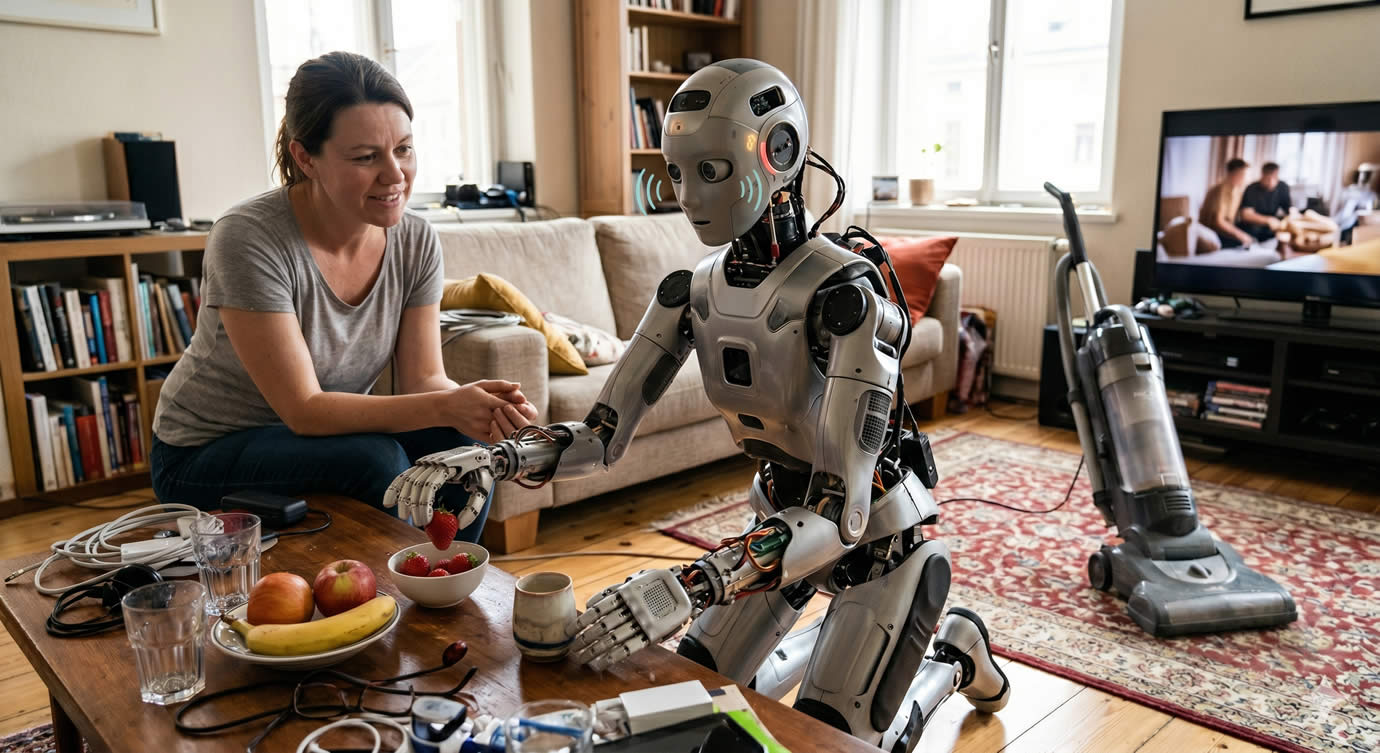
When a humanoid robot strolls across gravel without stumbling, or visually picks out an apple on a table, it is easy to assume these machines are nearly ready for our living rooms. Ask one to gently pick up a strawberry, however – or to understand a voice command delivered in a heavy accent while a vacuum cleaner howls in the background – and the failure rate is likely higher than you would expect.
Over the past few years, the “cerebellum” and “brain” of a robot have improved dramatically. Motion control and visual perception are no longer the biggest bottlenecks. Instead, touch and voice – two abilities that feel mundane to us – have become the toughest nuts to crack, and also the ones with the highest commercial stakes. The reason is straightforward: both demand that multiple sensors fuse data in an extremely short window, and the processing has to happen right at the edge. If latency creeps up even slightly, a glass shatters, or the robot earnestly replies “OK” to a line of dialogue from the television.
The Hand: A Processor Inside Every Fingertip
A human hand is dexterous because it simultaneously senses pressure, shear force, slippage and temperature, and can even tell silk from cotton. To give a robot hand comparable perception, engineers have capacitive, piezoelectric, optical, magnetic and resistive sensing technologies to choose from. Each comes with trade-offs, but the real bottleneck is not the sensors themselves. It is the torrent of data they produce.
Picture five fingers, each studded with multiple sensors sampling continuously at high frequency and in different modes. If every raw data frame were funnelled back to the main processor without any filtering, the central chip would drown and become unresponsive. So engineers have borrowed a page from biology: a hierarchical processing architecture.
At the fingertip, a touch-sensing chip no bigger than a fingernail runs lightweight machine-learning algorithms. It handles on-the-spot noise filtering, force detection and data compression. Most of the useless chatter is killed at the source, and only a condensed stream travels upstream to the palm.
In the palm, a sensing matrix of up to around 30 sensors determines where a touch is coming from, how strong it is, and in which direction it is moving. Crucially, this signal does not wait for the main processor to deliberate. It feeds directly into the motor-control system, forming a local closed loop. Much like a human adjusting their grip on a glass, if the pressure is slightly off, the loop corrects it within tens of milliseconds – no involvement from the brain required.
Power management, too, borrows a trick from smartphones. The “touch detection” function idles in a low-power mode and wakes the main system only when contact is registered.
On the connectivity side, industrial-grade high-speed links are already running at gigabit-per-second speeds. SerDes technologies such as FPD-Link, originally designed for automotive cameras, have made their way into robots. When data moves that fast, designers can split the workload flexibly between edge computing and the central brain – the edge handles what it can, and falls back to the main processor when necessary.
One detail that is easy to overlook: industrial robots are ahead of humanoids in this area. The grippers on robot arms have long used force-control technology for precision assembly. Those factory-hardened solutions are now migrating onto the hands of humanoid robots.
The Voice: Hearing Perfectly, Answering Poorly
If touch is about the subtlety of physical interaction, voice confronts a trickier problem: context. Speech recognition itself has made staggering progress – one industry insider estimated that today’s models are perhaps a hundred times more capable than those of just a few years ago. Yet the real-world embarrassment for humanoid robots is often not mishearing; it is responding inappropriately.
Several everyday scenes are enough to frustrate a designer.
Household noise is the first hurdle. A child chattering, a vacuum cleaner running, a football match on TV – the robot must pluck the genuine command out of the acoustic chaos. That demands a high-quality signal chain: high-SNR microphones, a solid audio codec, and an on-device hardware accelerator that can perform voice separation and recognition locally. Reaching out to the cloud for every utterance is not an option; latency and privacy won’t allow it.
Accent and phrasing are softer but maddeningly difficult. A Japanese user once complained about a voice-enabled product: the recognition was spot on, but the reply used overly casual language that felt disrespectful. “I don’t want to sound like an 18-year-old. I want the feeling of a 35-year-old.” That sentence captures the pain point exactly. Recognition and generation are essentially two separate systems, and tuning the generated speech to fit the user’s demographic – striking the right tone – is much harder than squeezing out another fraction of a percent in recognition accuracy.
More subtle still is the question of who is talking to whom. When someone in the room says, “My wife asked me to make her a coffee,” the robot must use context to understand the command is not meant for it. But what if the robot is the only other entity nearby? Should it respond? The emerging approach uses beamforming microphones that capture not just sound but also its direction and distance, factoring in the user’s body orientation to decide whether to engage.
Multilingual deployment then turns into a business headache. Is it better to build a single large English model to cover the globe, or train a dedicated model for each region? The former is big, demanding heavy compute and memory on-chip. The latter delivers a polished local experience but sends costs soaring. It is not merely a technical question; it is a brutal balancing act.
The Inescapable Trade-offs
Lay the requirements for touch and voice chips side by side, and a few fundamental tensions become clear.
- Edge versus cloud: edge processing is fast and privacy-friendly, but puts heavy demands on local silicon; cloud models are more capable, yet introduce latency and privacy risks.
- General versus local: a general model is broad and cost-effective, but the experience often feels rough; a localized model tuned for a specific language or accent lifts the experience but drives up chip and training costs.
- Centralized versus distributed: a centralized architecture saves hardware but can hit a bandwidth bottleneck when multiple sensors fire at once; a distributed setup is flexible and reliable, yet demands smooth coordination among several chips.
- Precision versus real-time: both touch and voice require high reliability, but humanoid robots have even less tolerance for latency than most industrial equipment. There is no room for stutter.
How Chipmakers Are Responding
Faced with these constraints, several silicon and IP players have laid out their roadmaps.
Synaptics is embedding machine learning into its touch controllers, focusing on local pre-processing to dramatically cut the load on the main system and give the “hand” enough autonomy to react. Texas Instruments is packaging signal chains, embedded processing and hardware accelerators together, betting on edge voice to handle separation and recognition at low power. Infineon is leaning on its MEMS microphones combined with edge AI to deliver room-scale visual and voice perception, aiming to give robots richer situational awareness.
On the vision and simulation side, Nvidia is bundling its physical AI chip IP with simulation libraries, working hard to close the notorious sim-to-real gap. Cadence, in collaboration with Nvidia, is trying to embed agentic AI into physical AI systems. Even in the comparatively mature field of vision, Synopsys and others continue to push higher-precision processing tailored for robots.
An interesting divergence is emerging. The Chinese market is sprinting ahead: robot vacuum cleaners there can already detect water stains, identify floor materials and autonomously plan cleaning routes, while voice interaction is being continuously polished. Europe, by contrast, remains more conservative, more obsessed with safety and reliability than with flashy features.
Looking forward, the path for touch and voice chip solutions is converging on a clear direction: sensor fusion, edge computing, and localized intelligence. Those technical threads may sound less dazzling than large language models, but for a humanoid robot, keeping a cup of water steady and getting a sentence right are probably the real battleground that will define the next generation of user experience. Whoever cracks these two nuts first will control the critical gate through which robots walk into everyday life.
