

Agility is selling a nine-minute charge, XPeng is selling a cell it calls solid-state, and warehouse operators are being sold a spare pack in the corner. All three are answers to a question the industry has not learned to price: what one productive robot-hour actually costs.
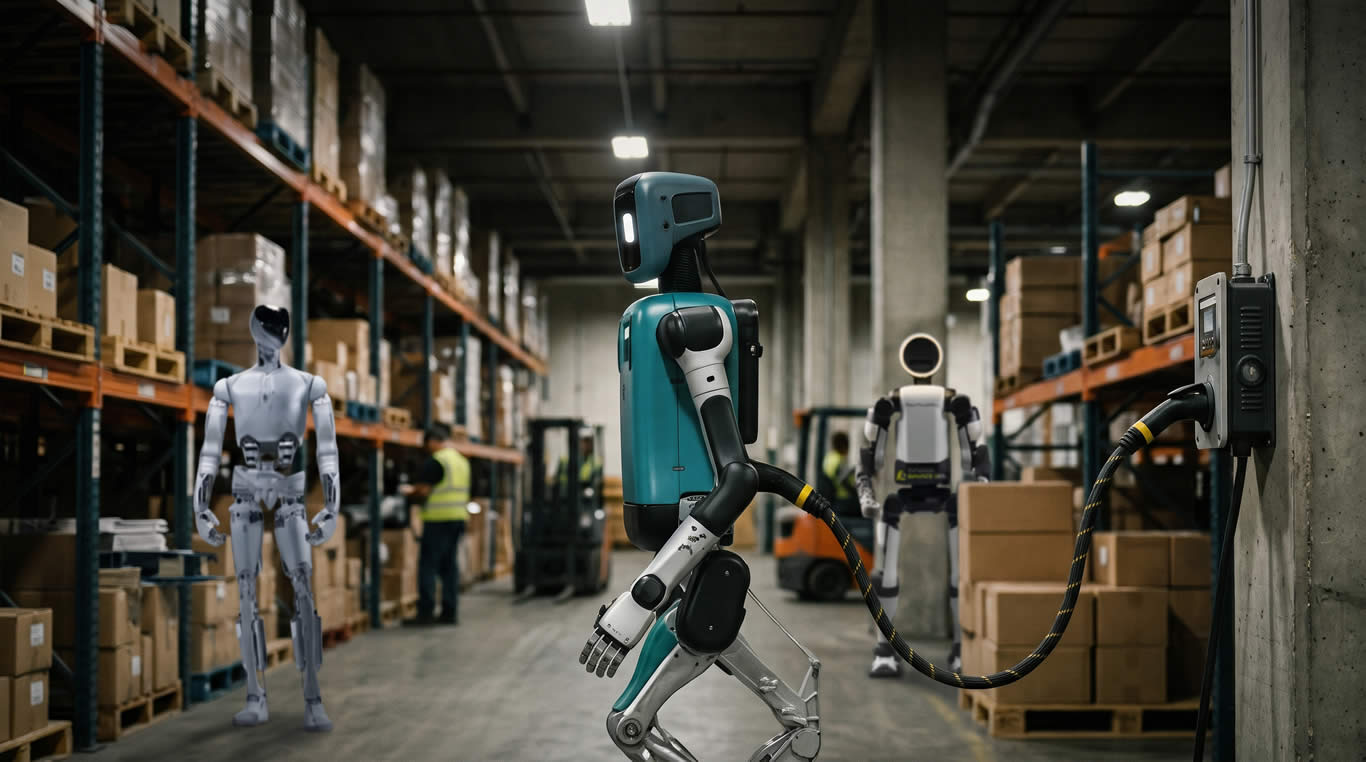
SALEM, OREGON — Ninety minutes of work, nine minutes on a cable, ninety more. Agility Robotics has built its pitch for Digit 5 around that ratio. The number it implies is not the one the company talks about. A machine that runs for an hour and a half and then needs nine minutes to come back spends a little over nine percent of its life plugged in. One hour in eleven; the rest is work.
No humanoid has come close to that duty cycle before, and in a warehouse it shows up first as a scheduling problem.
Agility says the ratio is good enough to extract more than twenty hours of productive work from every twenty-four, which would put a single Digit 5 past two full shifts. The arithmetic closes, just. What it does not cover is the walk to the charger, the docking, the queue when two robots arrive at the same stall, and the fact that a robot stalled in an aisle is not a stalled robot but a blocked aisle.
The company has not published the capacity of the pack, the charging power, or the cycle life. It has published a ratio, a supplier, and a date: early customer trials in the first half of 2027. Everything else is a promise about a product that does not yet exist in a customer’s hands.
Into that gap comes a set of numbers from IDTechEx. The British research firm, which has spent two years building out a humanoid robotics practice, puts the global market for humanoid robot batteries at $850 million in 2037, with total demand reaching 10.5 gigawatt-hours. The figures come from a report, Batteries for Humanoid Robots 2027–2037, that segments demand by application and by chemistry, down to the nickel content of individual cathodes.
A small number with a long shadow
Eight hundred and fifty million dollars is not a large market. GMInsights put the humanoid robot market at $7.9 billion in 2025 alone, and that estimate sits at the conservative end of what analysts publish. By the time batteries reach their forecast size, the machines will be selling in the tens of billions.
The pack is a modest slice of what a robot costs to build and a modest slice of what it costs to run, and it decides whether the rest of the capital earns anything at all. A robot that cannot finish a shift has to be replaced by a person, which is the one outcome the entire category exists to avoid. Component suppliers in other industries get to be wrong quietly. A pack that fails here fails in an aisle, in front of the customer.
The market also looks small for a duller reason. Battery demand is counted per robot, and the robots are still counted in hundreds. The pack inside Boston Dynamics’ Atlas is reported at roughly 1.3 kWh. At that order of magnitude, a market measured in gigawatt-hours is a market that implies a fleet measured in millions. What IDTechEx is really forecasting is a deployment curve, and that curve has not started.
The box has to do five jobs
A humanoid pack is asked to hold more energy than a power tool’s and deliver more power for its weight than an electric car’s, while sitting inside a machine that walks, falls over occasionally, and works within arm’s reach of people who are not wearing gloves.
Five requirements pull against each other. Energy density sets how long the robot works. Discharge power sets what it can lift and how fast, and a humanoid hoisting a loaded tote dozens of times an hour is a spiky load a car never sees. Safety stops being an abstraction the moment the pack sits a meter from someone’s chest, which makes thermal runaway a design constraint rather than a compliance checkbox. Cycle life matters more than in vehicles, because a robot working two shifts a day racks up cycles faster than a car plugged in twice a week. And cost has to land somewhere a warehouse manager can defend to a finance director.
IDTechEx’s reading of the field is that nickel-manganese-cobalt lithium-ion is the default, and will stay the default for a while. It is energy-dense enough, powerful enough, well supplied, and — decisively — already in production at scale. The report splits NMC by nickel content, from mid-nickel through 811 to 9.5.5, because pushing nickel up is the cheapest available way to buy energy density without leaving a chemistry the supply chain already makes by the million. Lithium iron phosphate, the chemistry that won the stationary storage market, is judged not energy-dense enough for a machine whose whole design problem is volume.
Beyond that, the two candidates have different failure modes. Solid-state cells promise above 400 to 500 Wh/kg by swapping the liquid electrolyte for a solid one and the graphite anode for lithium metal, which also removes the flammable component and frees volume for active material. The problems are industrial rather than theoretical: no scalable production of reliable solid electrolytes, and stubborn interface contact between electrode and electrolyte. IDTechEx expects volume manufacturing at the end of the decade, with BYD and Toyota carrying most of the weight.
Lithium-sulfur is the cheaper bet and the more distant one: abundant sulfur, high theoretical energy density, and a parasitic process called the polysulfide shuttle that eats active material cycle after cycle, leaving the cells short-lived and hostile to fast charging. Commercialization is not expected before the early 2030s.
No chemistry on that list is good at everything, which means the choice facing a manufacturer is not which cell is best but which of the five requirements it is willing to lose, and for which customer.
Nine minutes, and a prospectus
Agility’s answer is to lose energy density and buy back the difference with charging speed. Nyobolt, the British cell developer supplying the pack, has built its reputation on exactly that trade: high power in, high power out, in a small package. The claimed run-to-charge ratio is ten to one, against two to one on Digit 4 — a five-fold improvement in the number that determines how much of a day the robot spends earning.
Nyobolt’s chief executive, Sai Shivareddy, frames it as packaging: Digit 5 needed more power from a smaller, lighter pack, and reliability in a real warehouse was not negotiable. It is a reasonable thing for a supplier to say, and also what a supplier says when the customer has written a specification no incumbent chemistry can meet comfortably.
On November 5, Agility listed on Nasdaq under the ticker AGLT, merging with the special purpose acquisition company Churchill Capital Corp. XI and raising roughly $465 million before fees, including a $201 million private placement led by Foxconn. It is the first pure-play humanoid robotics company to trade in the United States, a few months behind Unitree’s listing on Shanghai’s STAR Market.
That changes what a design target means. A ratio announced in a press release is a marketing claim. A ratio that underpins a public company’s story about how its machines will earn money is a number analysts will ask about on every earnings call for the next two years, and that short sellers will test against field data. Agility is not yet profitable, and its valuation rests on how many robots it can get working and how long each one works each day. Nine minutes and twenty hours now sit in the filings.
The company’s own disclosures point the same way. It has expanded its deployment with the logistics operator GXO and described a pipeline of more than thirty prospective customers across manufacturing and automotive. Every one of those conversations ends in the same place: a duty cycle number, and a price per hour.
Swapping is thirty years old
The third route is presented as the newest, and it is the oldest. Warehouses have been changing forklift batteries with an overhead hoist or a roller bed for decades — hauling out a lead-acid block the better part of a ton, dropping in a charged one, and sending the truck back out. Nobody called it a business model; it was what you did so the truck did not sit idle.
What has changed is that a humanoid’s pack is small enough to be handled, and that the robot can be designed from the start around a module that comes out. The engineering is easier than it was for a forklift, and the commercial logic is harder.
Swapping does something peculiar to the market: it makes battery demand larger than robot shipments. An operator running a fleet on swap has to hold inventory — charged packs waiting on a rack — and that inventory is capital sitting still, degrading quietly, owned by somebody. IDTechEx folds spare packs into its forecast for precisely this reason, and it is the main argument for why a market of a few hundred thousand robots can support a battery market of any size at all.
Who owns those packs is an open question, and it is the same question the automotive industry has spent a decade arguing about with mixed results. Sell the pack with the robot and the operator eats the degradation. Lease it and the manufacturer carries residual value risk on a chemistry whose field life nobody has measured. Sell hours instead of hardware and the argument moves somewhere else entirely. Swapping is not a battery technology. It is a financing structure with a latch on it.
What the word solid-state is being asked to mean
XPeng took the opposite bet, and then leaned on the adjective.
On October 28, vice president Gu Jie told an industry conference in China that solid-state batteries built for Iron, its humanoid, had begun coming off the line in small batches, while the robot itself was still short of start-of-production. XPeng says it will begin mass production by the end of this year and deploy the robot in stores from 2027. The line that builds it was commissioned in September, with more than 80 percent of core processes automated.
The battery is designed around the constraints of a robot rather than a car: high energy density to fit a cramped chassis, a structure that stops thermal runaway from propagating, and cells that survive impact and nail penetration. Chinese coverage of the same presentation put the gain at 30 percent in gravimetric energy density. No absolute figure was published, and no production volume.
The adjective is the problem. When XPeng unveiled this generation of Iron in November 2025, it said the robot would use all-solid-state cells. In September, the outlet Jipian Lab reported that the production version would instead use a solid-liquid hybrid — semi-solid — chemistry, with a second-tier Chinese cell maker as the main supplier, because all-solid-state commercialization had not kept pace with the robot’s schedule. The October disclosure said “solid-state” without specifying which of the two it meant.
A 30 percent gain over a conventional pack is a real improvement. It is also roughly what a good semi-solid cell delivers. An all-solid-state cell, on IDTechEx’s numbers, is chasing 400 to 500 Wh/kg, which is a different order of claim. Nothing published so far supports the word.
The other difference between the two companies has nothing to do with chemistry. XPeng’s robots are going into showrooms, to greet shoppers and answer questions. Agility’s are going into distribution centers, to move totes. A showroom robot that spends an hour on a charger at lunchtime is invisible. A warehouse robot that does the same is a line item on somebody’s throughput calculation. The same word, uptime, means two different things, and only one of them is being stress-tested.
The number nobody publishes
Every announcement in this category leaves out the same number: the cost of a productive robot-hour.
That means an hour in which the machine is actually doing the thing it was bought to do, with chargers, spare packs, replacement cycles and maintenance folded in and divided by the hours it delivered. Not the sticker price of the robot, and not the sticker price of the pack — those are the two numbers every vendor is happy to give you. What nobody will quote is the per-hour figure. The companies now promising warehouse deployments are as quiet about it as Agility and XPeng are.
The absence is not a conspiracy; the denominator does not exist yet. You cannot compute cost per productive hour without field data on duty cycle, intervention rate and mean time between failures, and that data is being generated right now, in a few dozen buildings, by machines that have been working for months rather than years.
Written as arithmetic rather than as strategy, the three routes move different terms. Fast charging cuts the number of packs a site must own and adds chargers and idle minutes. Solid-state cuts packs and adds cost and schedule risk. Swapping cuts idle time and adds pack inventory. None of them reduces the total. Each chooses which line on the spreadsheet gets bigger.
That is what makes the forecasts less useful than they look. A number for 2037 is a number for a market whose unit economics have not been settled, priced against a chemistry mix that will not be final until the early 2030s, for machines whose duty cycles are currently being discovered by trial. The direction is not in doubt. The magnitude is a guess.
In a few years the most contested square meter in a warehouse may be the one with the cable hanging over it, not the floor the robot stands on. The forklift driver will still be there at four in the morning; the only question is whether he is waiting for a pallet, or waiting for a robot to finish charging.
