


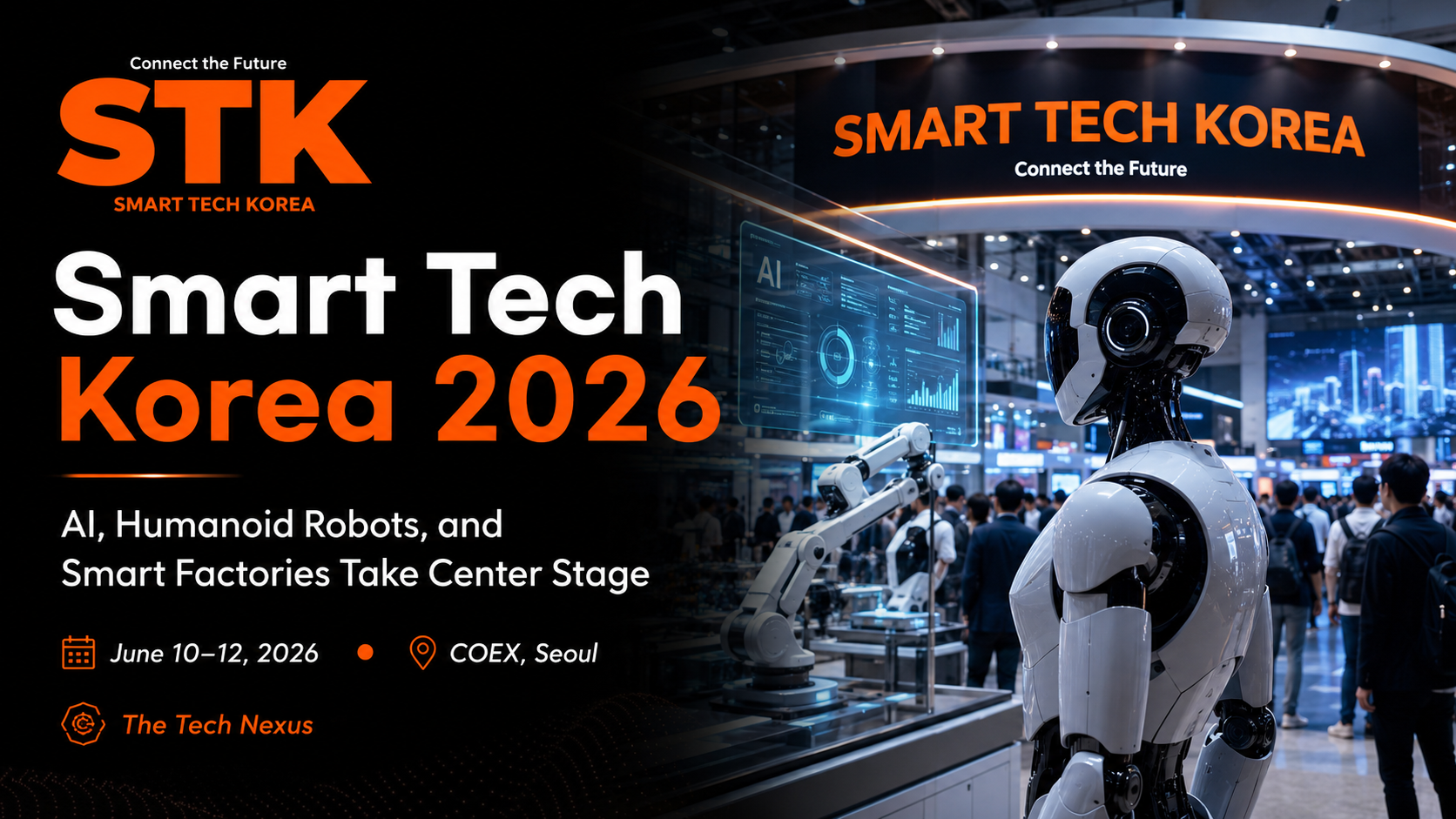
Smart Tech Korea 2026, Seoul’s biggest business tech show, runs from June 10 to 12 at COEX in Samseong-dong. For the first time, the event will use all four exhibition halls, A through D, expanding from three halls last year.
Last year’s turnout was about 52,000. This year, with the extra space, the target is more than 60,000. The official slogan is “The Tech Nexus — A Technology Ecosystem That Connects All Industries.”
The layout shows that shift clearly. First-floor Halls A and B focus on software and digital technologies, including AI agents, cloud services, data platforms, quantum computing, and XR. Third-floor Halls C and D cover hardware and industrial technologies, including humanoid robots, collaborative robots, AI factories, and logistics equipment.
Seven focused shows are running under the main banner: AI & Big Data Show, AI Factory Expo, Robotech Show, Digital Distribution & Logistics Fair, SecuTech Show, Smart Tech Show, and Korea Virtual Convergence Industry Expo.
Global Tech Giants at STK 2026
The organizing committee pushed the “Global AI Innovation Map” concept this year, lining up national tech strengths to show where different countries are making progress.
Canada is the guest country. The focus is Quebec’s MILA research institute, with robotics companies Mecademic, Robotiq, and Creaform showing industrial robots, automation equipment, and 3D measurement tools.
Israel is sending companies including SimilarWeb to show data-driven decision-making and smart manufacturing technologies.
The U.S. lineup includes Google, Nvidia, Microsoft, and Dell. Their themes include generative AI, AI agents, cloud infrastructure, and AI Factory roadmaps, with a focus on how enterprise AI can improve workplace efficiency.
Chinese Humanoid Robot Companies Take the Spotlight
At the Robotech Show, Chinese firms dominate one section of the floor.
AgiBot, Galbot, and Unitree are the full-platform humanoid robot makers. PaXini specializes in tactile sensing, providing the hardware that helps robotic hands tell the difference between rigid and soft objects. EngineAI focuses on lower-body motion, including walking balance and movement through complex environments. Linkerbot handles hand-motor control, which is used for tasks such as picking up objects, handing them off, and sorting small items.
The bigger news came just before the show. On June 2, AgiBot announced a three-way partnership with Xiamen Zhixing Mozuo and Sonokong, a Korean publicly traded group.
Under the partnership, AgiBot supplies the hardware and core algorithms. Zhixing Mozuo handles project coordination and localization. Sonokong brings its retail, chain-store, and education networks to support product distribution, channel development, and government-enterprise projects.
The product lineup covers commercial service robots, education robots, bionic robot dogs, and multimodal humanoid robots. Target use cases include K-12 technology labs, shopping mall demonstrations, and cultural park performances.
The New AI Factory Expo
The AI Factory Expo is a new section of Smart Tech Korea 2026, and it is set up differently from a standard exhibition area.
Instead of only displaying booths, the expo includes a dedicated consultation and business-matching program hosted by Naver Cloud. The program connects manufacturing AI suppliers with real buyers. Organizers said early registration slots for the consulting sessions filled up and closed ahead of schedule, which points to strong demand from Korean manufacturers.
This also fits with the government’s recently rolled-out AI-Based Smart Manufacturing Innovation 3.0 Strategy. The target is to get 10% of small and medium manufacturers using AI by 2030, build 12,000 AI-powered smart factories, and turn Korea into a regional test bed for advanced manufacturing.
Dell and Nvidia are showing their AI Factory platform, including PowerEdge XE9680 servers, H100 GPUs, and PowerScale storage. The setup covers the full pipeline from model testing to deployment.
Samsung SDS is also attending with its AI transformation pitch for manufacturing, retail, and service industries. Its showcase includes Brity Copilot and FabriX GenAI services.
Quantum Computing and Cybersecurity Also Move Into Focus
There is a dedicated quantum pavilion this year. AWS, Quantum Intelligence, and ID Quantique are showing technologies related to quantum computing hardware, cybersecurity, drug development, and education infrastructure.
ID Quantique is also giving a talk on building hybrid quantum-safe infrastructure, including QRNG, PQC, and QKD. The topic is tied to the “harvest now, decrypt later” threat, where attackers collect encrypted data today and wait for future quantum computers to break it.
Why Smart Tech Korea 2026 Matters
Smart Tech Korea 2026 puts more attention on how AI, robotics, smart manufacturing, and security technologies can be used in real industrial settings.
With expanded exhibition space, a new AI Factory Expo, a larger robotics presence, and participation from global technology companies, the event shows how Korea is positioning itself for the next stage of industrial AI.
